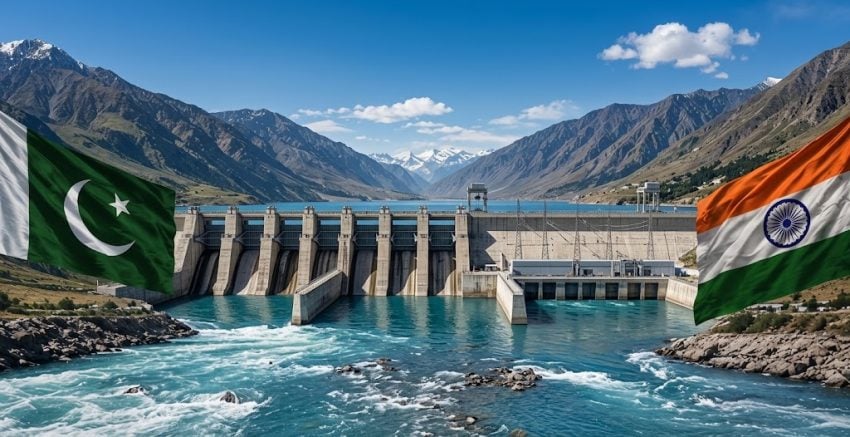
THE HAGUE – A major legal battle over the Indus river system intensified after Permanent Court of Arbitration (PCA) in The Hague ruled that the Indus Waters Treaty remains fully in force, rejecting India’s unilateral decision to place the decades-old water-sharing agreement in “abeyance.”
Court concluded that India had no legal basis under the treaty or international law to suspend or terminate the agreement on its own. The tribunal also imposed interim restrictions on specific construction activities at India’s Ratle Hydroelectric Plant in Jammu and Kashmir, pending further technical examination by a Neutral Expert.
India rejected the ruling, calling the Court of Arbitration “illegally constituted” and insisting that its April 2025 decision to keep the treaty in abeyance remains valid.
August 31 proceedings produced two major outcomes in the long-running dispute. The first was an Award on the Status of the Indus Waters Treaty, examining whether India could legally place the 1960 agreement in abeyance. The second was an Order on Interim Measures concerning the Ratle Hydroelectric Plant, addressing Pakistan’s request for restrictions on certain construction activities while technical questions surrounding the project remain under review.
On the treaty question, the tribunal unanimously concluded that none of the grounds advanced by India provided a legal basis for suspending or terminating the agreement.
The Court determined that the treaty therefore continues to remain fully operational, meaning India remains bound by its obligations concerning the western rivers and the design and operation of hydroelectric projects on them.
The tribunal examined India’s use of the term “abeyance” and found that the expression does not appear in the Indus Waters Treaty and has no established technical meaning in international treaty law.
The Court therefore considered whether India’s action effectively amounted to an attempt to suspend or terminate the treaty. Its conclusion was clear: the treaty contains no provision allowing either country to unilaterally suspend or terminate it. Instead, the agreement provides for modification or termination through a mutually agreed treaty between India and Pakistan.
The Court also rejected the argument that national sovereignty itself allowed India to disregard its treaty commitments, emphasizing the international-law principle of pacta sunt servanda — essentially, that agreements entered into by states must be honored
The ruling means that, from the tribunal’s legal perspective, India cannot simply declare the treaty inactive and then disregard the obligations it imposes.
The tribunal also examined the circumstances India had cited in support of its 2025 decision. These included Pakistan’s alleged failure to cooperate on treaty modification, security concerns, cross-border terrorism and the broader deterioration in bilateral relations.
On India’s claim that Pakistan had refused to negotiate changes to the treaty, the Court found that the agreement did not impose an obligation on Pakistan to enter such negotiations. The tribunal also examined correspondence between the two governments and found indications that Pakistan had been willing to discuss possible modifications.
The Court therefore concluded that this argument did not establish a legal basis for suspending the treaty
The second major development concerns the Ratle Hydroelectric Plant, a project on the Chenab River that has long been disputed by Pakistan. The Court ordered India to limit certain construction activities at the project while the Neutral Expert continues its technical assessment.
New Delhi has been prohibited from carrying out specified concreting work on parts of the dam wall and power-intake structure above prescribed levels until 90 days after the Neutral Expert issues its final decision. The technical determination is currently expected around July 2027. India must also provide information concerning the project’s construction schedule.