ISLAMABAD – The National Database and Registration Authority (Nadra) will commence the issuance of facial recognition-based biometric verification certificates at all its registration centres for those citizens whose fingerprint-based verification is not possible from January 20, 2026.
Under this procedure, if fingerprint-based biometric verification fails at the service provider’s end, the citizen will visit the nearest NADRA Registration Centre to have a fresh photograph taken. This photograph will be matched with the image already available in NADRA’s records.
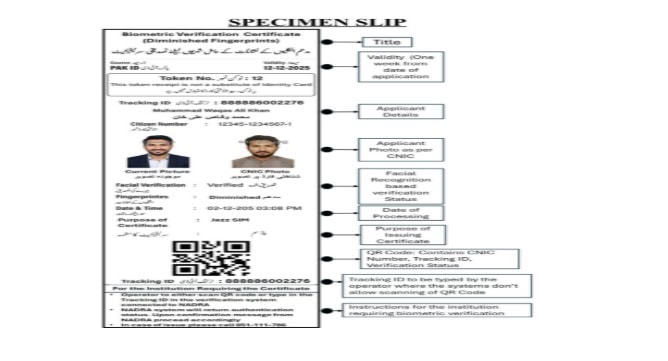
Upon successful verification, NADRA will issue a certificate containing the purpose of verification, the citizen’s recent photograph alongside the photograph on record, CNIC number, name, father’s name, a unique tracking ID and a QR code.
The certificate will be valid for seven days. The citizen will submit it to the relevant institution where biometric verification was required and the concerned institution will incorporate the certificate into its records and verify it online through NADRA.
In the future, facial image-based biometric verification certificates will also be available through NADRA’s e-Sahulat franchises. Following the formal launch of the Digital ID, this facility will be made available for all services through the Pak-ID application.
NADRA is fully prepared to implement this system. However, for its effective execution, NADRA has requested all regulators, relevant public institutions and private sector organisations to progressively upgrade their hardware and software in accordance with approved standards to enable the use of this biometric verification service.
In the first phase, technical upgrades to institutional software applications will be required to allow the integration of facial recognition-based biometric verification certificates issued by NADRA. In the second phase, it will be necessary for institutions to install cameras at service counters or integrate cameras into existing KYC biometric machines, as without these upgrades, NADRA cannot provide this facility directly at such locations.
If citizens encounter any issues regarding the availability of this service after 20 January 2026, they may lodge complaints with the relevant institution or department, as the service will be available from NADRA’s end.
To ensure the earliest possible operationalisation of this facility, NADRA has also requested the Ministry of Interior to issue appropriate instructions to all concerned institutions. It is envisaged that, following the rollout of this system, the difficulties faced by citizens due to faded fingerprints will be effectively resolved. Upon full implementation, citizens will be able to avail this facility directly at the relevant institution without the need to visit a NADRA Registration Centre. Following the formal launch of the Digital ID, citizens will also be able to access this facility independently through the Pak-ID application.