The Middle East crises have pushed us to wonder how the wheels of an Internal Combustion Engine (ICE) car move when the most vital part of creating high pressure to move the piston down, so that the vehicle keeps running, remains missing: oil. The war in Iran has disrupted the oil supply chain, as one-fifth of the world’s Liquefied Natural Gas (LNG) and oil cannot pass through the essential Strait of Hormuz.
It raises many questions regarding the future of traditional oil-run automobiles and Electric Vehicles(EV’s). Reports suggest that the change will be gradual; therefore, one must consider the benefits of not relying on an oil-powered automobile. The alternative to oil is widely known as Lithium-ion (Li-ion) batteries, which store energy and release it when required.
How do Lithium-ion batteries work?
These batteries consist of two electrodes, the positive (cathode) and the negative (anode), separated by an electrolyte that helps lithium ions move between them. They move from one electrode to another, acting as a power source to an EV. To recharge, the process must be reversed, with the lithium ions returning to their original positions.
The work is simple; however, the most crucial part of a Li-ion battery is the electrolyte, but it also acts as the most dangerous substance. In an unlikely scenario where the battery overheats, the electrolyte between the two electrodes can fuel the fire, mainly due to its flammable components.
Similar incidents have been witnessed in the past; the most populous province in Canada, Ontario, saw a Tesla catch fire. In the same year, 2024, a high-speed crash in Toronto led to the death of four passengers. The incident had a devastating effect on the masses, even though evidence suggests otherwise. The risk of an EV bursting into flames whilst driving is extremely low, but public anxiety grew.
What’s the Solution?
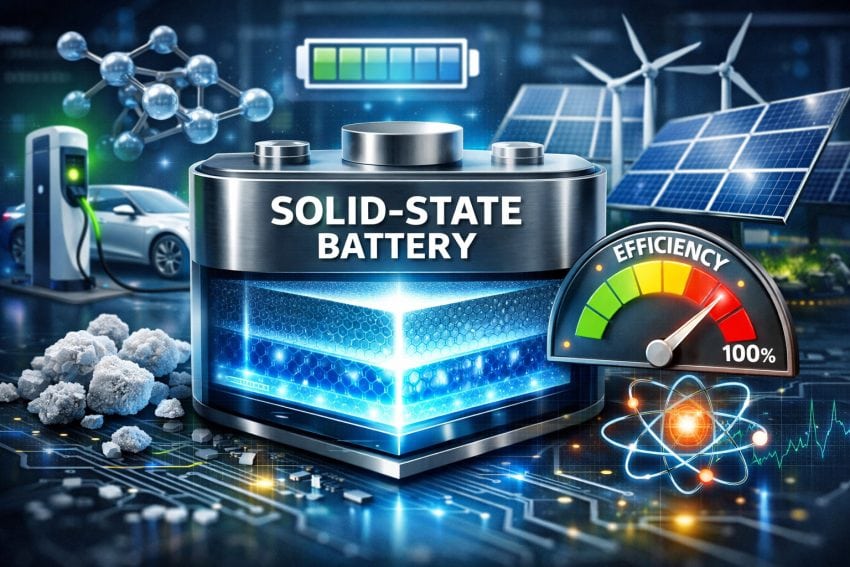
The solution to these unlikely events is presented in the form of ‘Solid-State Batteries’, the question is how?
When Li-ion batteries are damaged or overheated, the liquid electrolyte can fuel a fire, but if that liquid electrolyte is replaced with a solid electrolyte, the substance that acts as a power source to ignite the fire is removed, thereby addressing public fears about EV batteries.
Chinese advancement in Solid-State Battery technology
On October 18th, renowned Chinese Automaker Chery unveiled its first solid-state battery. The prototype achieved a 600 Wh/kg energy density, twice that of Li-ion batteries. According to reports, it will provide EV’s with a driving range of approximately 800 miles. Chery has claimed that introducing this battery into EVs would eliminate previous concerns associated with lithium-ion batteries.
Chery’s Chairman Yin Tongyue announced plans to begin vehicle trials in 2026 and move to full-scale production by 2027, potentially putting it ahead of domestic rivals BYD and CATL, which are aiming for limited solid-state battery output around the same period.