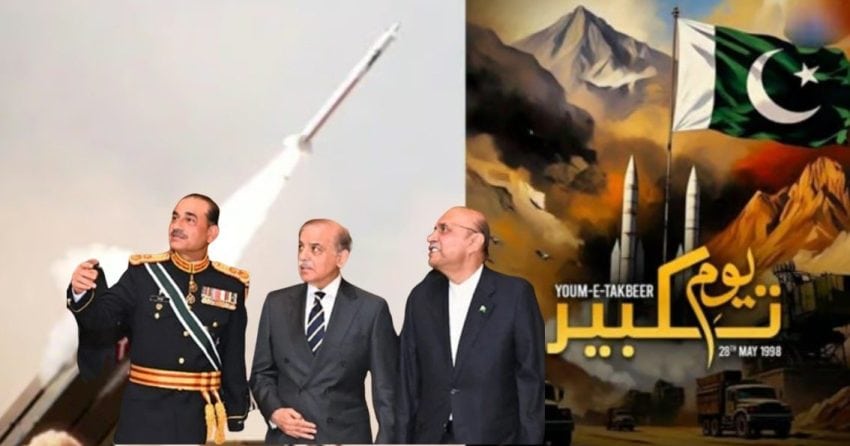
ISLAMABAD – Pakistan’s civil and military leadership came together to mark Youm-i-Takbeer, revisiting the moment in 1998 when nuclear tests in Chagai redefined its security landscape.
Pakistan conducted historic nuclear tests of May 28, 1998 in the Chagai hills that officially made the country a nuclear power and, as leaders described, restored the strategic balance in South Asia.
In his message, Prime Minister Shehbaz Sharif called the day defining moment in Pakistan’s history, saying it reflected “resolve, unity and courage” in the face of external pressure. He said the decision to conduct nuclear tests was taken in response to India’s earlier nuclear explosions and was aimed at protecting Pakistan’s sovereignty and defence capability.
The premier said Pakistan moved forward with the tests despite intense international pressure, sanctions, and diplomatic efforts to dissuade it. He said the step sent a clear signal that the country would not compromise on its security. He added that the achievement continues to serve as a strong deterrent, ensuring peace through balance rather than vulnerability.
Sharif paid tribute to those who contributed to the programme, naming former prime ministers Zulfikar Ali Bhutto and Nawaz Sharif, along with scientists Dr Abdul Qadeer Khan and Dr Samar Mubarakmand, engineers, technicians, and armed forces personnel who played a role in the nuclear development process.
He said Pakistan’s nuclear capability remains a cornerstone of national defence and a symbol of unity and sacrifice. Referring to recent regional tensions, he said Pakistan had demonstrated strong resolve in the face of hostile actions during “Marka-i-Haq,” alleging that India had staged a false-flag incident in occupied Kashmir’s Pahalgam to justify targeting civilians. He said Pakistan’s response, under what he termed “Bunyanun Marsoos,” reflected national cohesion and military readiness.
PM also praised country’s military leadership, including Chief of Defence Forces Field Marshal Asim Munir, Air Chief Zaheer Ahmad Babar, and Naval Chief Admiral Naveed Ashraf, for maintaining operational preparedness and professionalism.
He also warned that Pakistan remained vigilant against threats from proxy groups, naming Fitna al Khawarij and Fitna al Hindustan, and said ongoing counterterrorism operations would continue until such networks were eliminated. He reaffirmed that while Pakistan seeks peace, it retains the full right to defend itself against any aggression.
President Asif Ali Zardari, in a separate message, also termed Youm-i-Takbeer a landmark in Pakistan’s history, saying it marked the day the country emerged as a declared nuclear power and secured credible deterrence.
He said the 1998 tests were carried out in response to India’s nuclear developments and despite economic sanctions and international pressure. He credited political leadership, scientists, engineers, and the armed forces for what he called a “collective national achievement” that strengthened Pakistan’s security.
Pakistan Armed Forces said Youm-i-Takbeer is day of national unity, resilience, and an unwavering commitment to safeguarding sovereignty and territorial integrity. Calling 1998 nuclear tests as a defining milestone achieved through visionary leadership, scientific excellence, and the sacrifices of both military personnel and civilians.
ISPR said Pakistan’s strategic capability remains a “credible deterrent” ensuring peace and stability in the region.
The military leadership reaffirmed that the armed forces remain fully prepared to defend the country against all threats and will continue to uphold national security, stability, and progress with resolve and unity.