
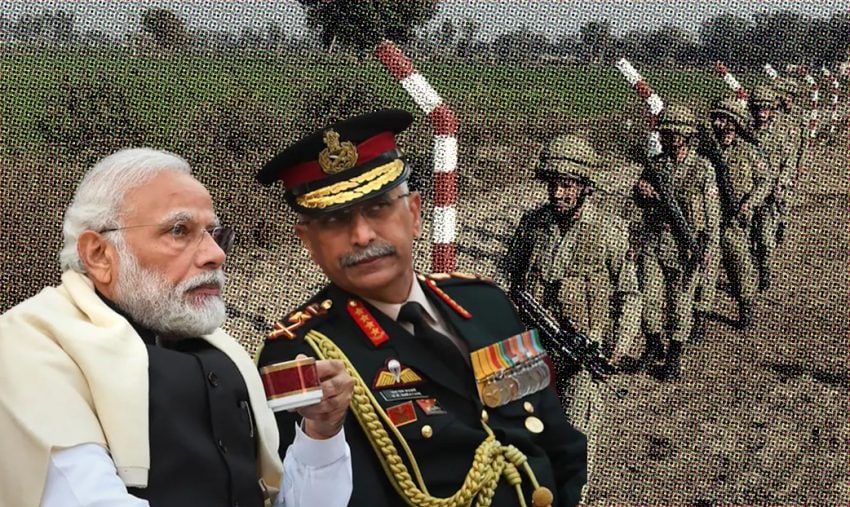
NEW DELHI – Former Indian Army Chief General Manoj Mukund Naravane revealed that Indian military commanders stationed along Pakistan border enjoy greater operational freedom than those deployed against China.
He said troops at Pakistan border can respond with immediate firing in certain situations while China front follows a different set of engagement rules.
The retired army chief amassed sharp distinction between India’s two most sensitive borders, linking difference to what he described as terrorism-related threat emanating from Pakistan. “Pakistan and China are completely different situations,” Naravane said, explaining that commanders on the ground are empowered to act within their mandate, but that the circumstances on the Pakistan border often allow for immediate armed responses.
The remarks have added fresh fuel to an already heated debate surrounding Naravane’s unpublished memoir, Four Stars of Destiny, portions of which have triggered political controversy in India over the handling of the 2020 Galwan Valley crisis with China.
Excerpts published by The Caravan suggested that during the deadly Galwan confrontation, military commanders were operating under strict instructions regarding the use of force. Asked directly about reports that troops were ordered not to open fire without approval, Naravane declined to comment, saying the manuscript remains under review by the Ministry of Defence.
The former army chief’s comments come as opposition leader Rahul Gandhi continues to question the government’s handling of the China border standoff, arguing that revelations from the memoir raise uncomfortable questions about decision-making during one of the most serious military crises in recent Indian history. The government has rejected those allegations.
Naravane, however, firmly defended Prime Minister Narendra Modi’s controversial assertion following the Galwan clash that no Indian territory had been lost. “I repeat that no territory was lost. What the Prime Minister said was absolutely correct,” he said.
2020 Galwan Valley clash left 20 Indian soldiers dead and pushed relations between Asia’s two largest powers to their lowest point in decades. Naravane described the confrontation as a result of differing perceptions of the border rather than a loss of territory, while acknowledging that China’s intentions remain difficult to decipher.
“China is not easy to understand,” he said, calling for deeper strategic and academic research into Beijing’s objectives and long-term ambitions.
Blocked by Pakistan, Air India looks to China’s military command for lifeline