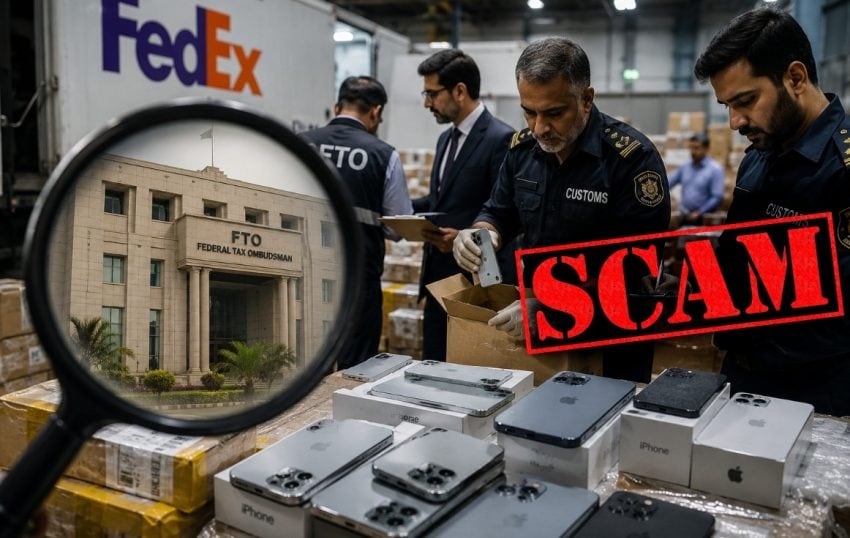
A Pakistani man paid all required taxes, completed legal formalities and waited for his new iPhone 16 to arrive. But the device never reached him. Instead, it was allegedly released to someone else using forged documents, a case that now prompted Federal Tax Ombudsman to order a nationwide investigation into a suspected courier and Customs fraud network.
The suspected iPhone 16 import scam triggered alarm, showing the alleged role of FedEx, Customs officials and private individuals and it is said to be part of much larger fraud network.
Federal Tax Ombudsman Zafar Hijazi said evidence pointed towards an “organised scam” that deprived the rightful owner of duty-paid smartphone for more than 1.5 years, despite the completion of all legal import and tax formalities.
Muhammad Nausherwan Khan filed a complaint, syaing his sister sent him an iPhone 16 Plus from Canada through FedEx in December 2024. The handset reached Karachi, where he paid Rs1.28Lac in PTA taxes to clear the device. Despite paying the required tax, Khan claimed he never received the smartphone. He later discovered that the device had allegedly been released to another person after a forged authority letter was reportedly used to obtain its clearance.
During the proceedings, Customs authorities defended the clearance process, saying the shipment had been released after a licensed clearing agent produced the original detention receipt, invoice and other required documents. FTO questioned how the phone could be handed over to someone else when the complainant remained the officially declared consignee on the import documents and had personally approached Customs authorities to claim the parcel.
The inquiry further uncovered suspicious discrepancies in the shipment records. While the consignee’s name remained unchanged in the import documents and tracking system, the delivery address and contact details had allegedly been replaced with those of another individual on the airway bill and invoice.
Calling these irregularities too significant to be dismissed as mistake, officials observed that the apparent manipulation of official shipping documents suggested the existence of a coordinated fraud that could extend well beyond a single case.
Although the complainant later informed the Ombudsman that his personal grievance had eventually been resolved, FTO decided to pursue the matter further, saying the public interest demanded a comprehensive investigation into whether similar cases had occurred elsewhere in the country.
FTO now directed Federal Board of Revenue (FBR) to instruct the Chief Collector of Customs (Airports) to launch a targeted inquiry into FedEx’s courier clearance operations. The investigation will also examine courier import data from January 2025 to June 2026, identify other potentially affected consignments, probe the alleged use of forged authority letters, scrutinise the conduct of Customs officials who may have facilitated the scheme, and initiate legal as well as disciplinary action wherever wrongdoing is established.
They further recommended introducing uniform Standard Operating Procedure (SOP) for courier import clearances at all international airports to strengthen verification mechanisms and close loopholes that could be exploited by fraudsters.
iPhone, Samsung and Pixels Hit by Customs Crackdown on Used Imports in Pakistan