Pakistan’s rapidly expanding distributed solar market is creating new opportunities for battery energy storage systems as businesses look for ways to make renewable energy more reliable and flexible.
Research from Ember and Renewables First estimates that Pakistan now has around 38 gigawatts (GW) of distributed solar capacity across residential, commercial, industrial and agricultural sectors. As solar adoption continues to grow, industry experts say the next challenge is improving energy availability and managing supply according to demand.
Trina Storage, the energy storage division of global solar technology company Trinasolar, said Pakistan’s growing solar base is increasing interest in solar-plus-storage solutions, particularly for utility-scale projects and commercial and industrial microgrids.
According to a Renewables First report, Pakistan imported 4.6 gigawatt-hours (GWh) of battery energy storage systems in 2025, representing a 220 per cent increase compared with the previous year.
The company said integrating battery storage with existing solar installations does not require replacing current solar assets. Instead, properly designed solar-plus-storage systems can help businesses improve renewable energy utilisation, increase operational flexibility and strengthen energy resilience.
However, experts caution that adding storage to existing solar infrastructure requires detailed planning rather than a simple installation process. Each project needs assessment of electrical systems, inverter compatibility, energy demand patterns, control systems, safety requirements and long-term operational objectives.
For many existing solar projects, an AC-coupled configuration can provide a practical option. Under this arrangement, battery storage operates alongside the existing solar system through a separate Power Conversion System, allowing much of the original solar infrastructure to remain operational.
Despite its advantages, system compatibility remains a key consideration. Developers need to evaluate electrical connections, communication systems, control mechanisms and compliance with international safety standards, including IEC and UL requirements.
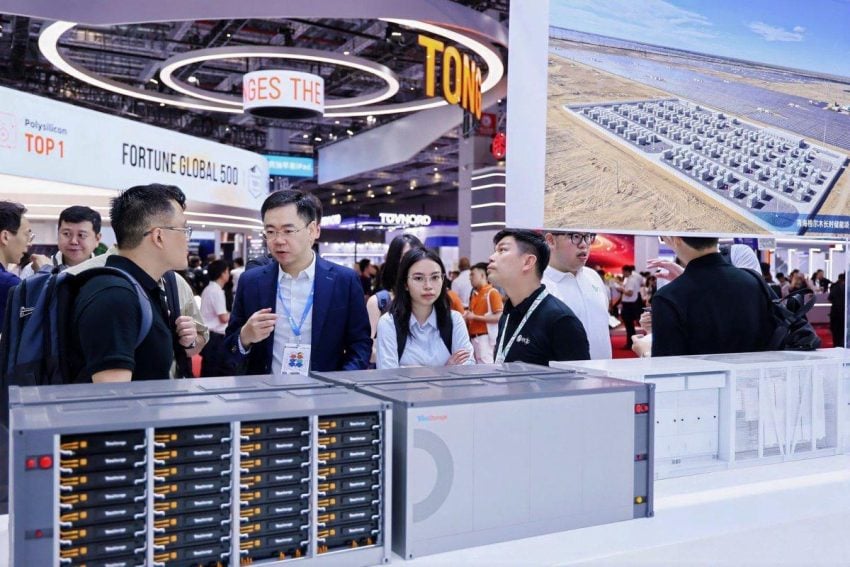
Trina Storage said its Elementa Series has been developed for utility-scale and commercial and industrial applications. The system is designed to integrate with solar-plus-storage projects using both Trina equipment and third-party components, depending on the technical requirements of each installation.
The company added that it works with customers and engineering, procurement and construction (EPC) partners to assess compatibility, select suitable battery configurations and develop operating strategies based on individual project needs.
Trinasolar has maintained a presence in Pakistan’s solar sector and has supplied more than 500MW of solar modules rated above 700 watts for commercial, industrial and residential applications. The company recently introduced its Vertex N G3 760W solar module series in the market.
Globally, Trina Storage was established in 2015 and has maintained BloombergNEF Tier 1 Energy Storage Manufacturer status for ten consecutive quarters. The company expects cumulative energy storage shipments to exceed 30 GWh by the first half of 2026.
Its latest platform, the 6.25MWh Elementa 3, combines advanced battery technology, thermal management systems and built-in safety features designed for large-scale energy storage projects.