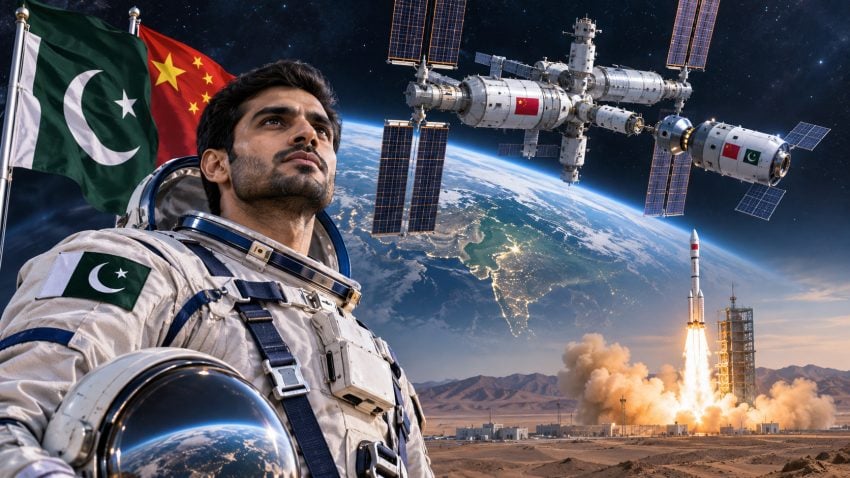
ISLAMABAD – China enters final stages of preparations to send first Pakistani astronaut to Tiangong Space Station aboard Shenzhou-24 spacecraft.
The mission moved major step closer after China reportedly transferred the Shenzhou-24 spacecraft and its powerful Long March-2F carrier rocket to the launch pad at the Jiuquan Satellite Launch Center on November 17. Preparations have entered their final phase, with technical inspections, system checks and other arrangements underway ahead of the expected liftoff.
If successful, the mission would make Pakistan the first foreign country to send an astronaut aboard China’s Tiangong Space Station, marking a significant achievement for the nation’s growing space programme.
Under mission plan, a Pakistani astronaut will travel alongside Chinese crew members to the Tiangong Space Station, where the country’s representative will spend approximately seven days conducting scientific experiments and operating specialized research equipment.
Pakistani astronaut will serve as a payload specialist, playing an active role in scientific investigations rather than simply participating as a passenger. After completing the week-long assignment, the astronaut is expected to return to Earth aboard the Shenzhou-23 spacecraft, which will already be docked at the orbital station. Chinese astronauts will continue their extended mission, expected to last approximately six months.
Two Pakistani military pilots have been selected as candidates for the groundbreaking mission, but only one will ultimately travel into space. Muhammad Zeeshan Ali of the Pakistan Air Force and Khurram Dawood of the Pakistan Navy were selected in April 2026 following a rigorous screening and assessment process.
Both candidates have spent months undergoing intensive astronaut training at the China Astronaut Research and Training Center in Beijing. Their training includes adapting to weightlessness, understanding complex spacecraft systems, operating scientific equipment, responding to emergencies and learning Mandarin to ensure effective communication with Chinese astronauts and mission controllers.
One of the candidates will be selected as the primary astronaut, while the other will serve as a backup. Chinese authorities have yet to officially reveal which Pakistani pilot will make the historic journey.
Beyond its historic significance, the mission will open new opportunities for Pakistani scientists and researchers to conduct experiments in space. Pakistani astronaut is expected to carry approximately four scientific research payloads selected from more than 300 proposals submitted by universities and research institutions.
These experiments will be conducted in the unique microgravity conditions aboard the Tiangong Space Station, allowing researchers to investigate scientific processes that are difficult to reproduce on Earth.
The historic mission follows a major agreement signed in February 2025 between Pakistan’s Space and Upper Atmosphere Research Commission (SUPARCO) and Chinese space authorities in Islamabad. The agreement established the framework for selecting, training and sending Pakistani astronauts to China’s space station.
After a demanding selection process, the two Pakistani candidates were chosen in April 2026 and began specialized training in China. The mission represents another major expansion of Pakistan-China cooperation in space technology, building on existing satellite programmes, lunar exploration initiatives and broader collaboration under the Belt and Road Initiative.
The two countries are also pursuing future lunar exploration projects, including plans associated with Pakistan’s proposed Jinnah-1 lunar rover. China’s decision to include a Pakistani astronaut in its human spaceflight programme also highlights Beijing’s growing ambitions to expand international participation in space exploration.
China selects two Pakistani astronauts for historic space mission
With the Shenzhou-24 spacecraft and Long March-2F rocket reportedly moved to the launch area, attention has turned to the final countdown. Federal Minister for Planning Ahsan Iqbal previously indicated in October that the historic mission was expected to launch on November 25, 2026.
Independent space launch trackers have also pointed toward a launch around the same date, raising expectations that Pakistan’s first astronaut could begin the journey within days. However, the China Manned Space Agency has not yet officially confirmed the final launch schedule, maintaining that the mission will proceed once all technical and operational requirements have been completed.
The mission could also provide valuable experience in astronaut training, space station operations and scientific research, laying the groundwork for more ambitious Pakistani space initiatives in the years ahead.