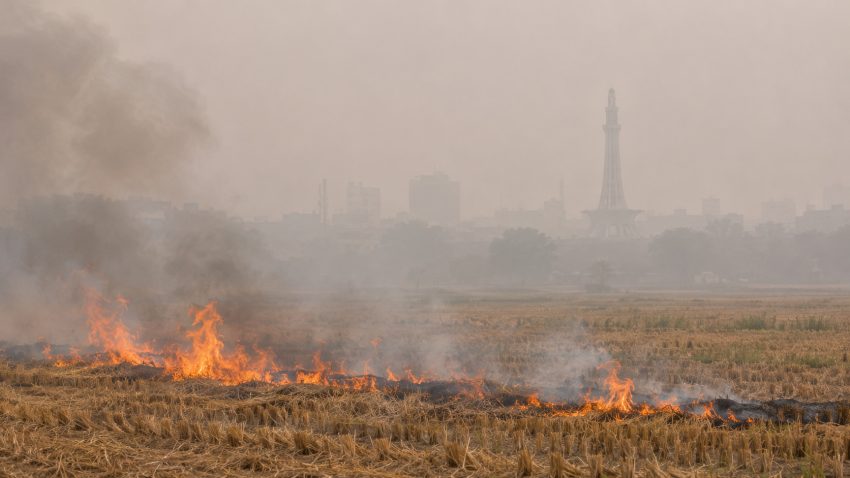
LAHORE – Punjab recorded more than four times as many satellite fire detections as Indian Punjab during the first 29 days of October, while Lahore breached national air-quality limits throughout the month despite a weather-driven improvement in pollution levels.
Two separate environmental assessments show a continuing threat, one of agricultural burning intensified towards late October, and cleaner air in Lahore did not change into safe conditions for residents.
Environmental monitoring platform HamariHawa identified 13,241 fire spots in Pakistan’s Punjab between October 1 and 29, against 3,158 in Indian Punjab, approximately 4.2 times as many. independent Pakistan Air Quality Initiative reported that Lahore’s air was 27% cleaner than in October last year. It attributed most of that improvement to favourable weather rather than progress in tackling pollution at its source.
Even with the improvement, all 31 days exceeded Pakistan’s legal air-quality limit, while pollution remained almost seven times the level considered safe under World Health Organization guidelines, according to the initiative.
Pakistan Air Quality Initiative recorded 35% fewer satellite-detected crop fires across Punjab on both sides of the border. However, it warned that burning started around a week later this year, potentially pushing some of the smoke impact into November.
HamariHawa’s findings showed a pronounced increase in burning towards the end of its reporting period. The final seven days accounted for 6,655 detections, roughly half the total, with a daily peak of 1,327 on October 29.
Its assessment drew on NASA’s Fire Information for Resource Management System, using VIIRS observations from three satellites. About 92% of the fire detections in Pakistan’s Punjab fell on farmland, suggesting crop-residue burning.
A separate comparison using only the Suomi NPP satellite recorded 4,562 detections in Pakistan’s Punjab and 918 in Indian Punjab. Those numbers contrast sharply with the corresponding period in 2019, when Indian Punjab recorded 14,002 detections, compared with 2,908 in Pakistan’s Punjab.
Satellite-detected crop fires in Indian Punjab fell by 95% between 2021 and 2025, while detections in Pakistan’s Punjab increased by 33% between 2019 and 2025. In 2025, Pakistan’s Punjab recorded 12,364 detections, against 3,714 in Indian Punjab.
Okara emerged as largest hotspot in the latest district breakdown, registering 2,144 fire detections. Gujranwala followed with 1,011 and Nankana Sahib with 1,003. Together, the three districts recorded more fire spots than the entire Indian Punjab region during the reporting period.
Smoke from agricultural fires could aggravate Lahore’s pollution depending on wind direction. However, HamariHawa stressed that satellite detections do not establish how much land burned or how much smoke entered the atmosphere. Clouds, dense smoke and gaps between satellite passes can also leave fires undetected, limiting what the figures reveal about the full extent of burning.
The platform said it applied the same methodology to both sides of the border and found a strong correlation between its Indian Punjab results and official Indian counts. Pakistan, it noted, does not have a comparable publicly available daily official dataset.
Meanwhile, Punjab’s Environment Protection Agency stepped up enforcement against brick kilns, industrial emissions, plastic burning and construction dust. Between September 28 and October 27, officials conducted 11,580 brick-kiln inspections. Authorities demolished 197 kilns, sealed 163, registered 162 cases and imposed Rs40.7 million in fines.