
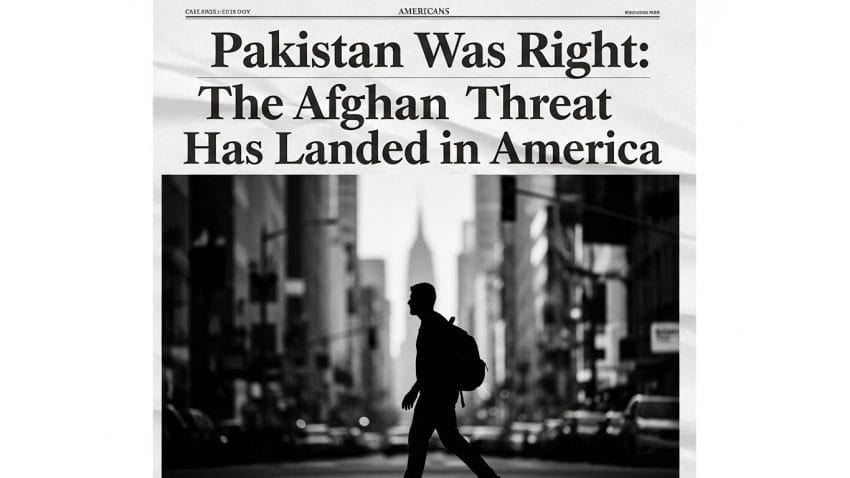
There is a tragic irony in international relations: often, the ally warning most loudly about a fire is ignored until the smoke begins to choke the skeptic’s own house. For decades, the Islamic Republic of Pakistan has stood at the global podium, offering a grim and consistent warning about the instability radiating from Afghanistan. Washington, and indeed much of the Western world, frequently dismissed these concerns as regional maneuvering.
But today, as breaking news flashes from Texas to the urgent corridors of the Department of Homeland Security, an undeniable reality has settled over the United States. Pakistan was right.
In a disturbing development that should alarm every American family, authorities in Texas have arrested Mohammad Dawood Alokozay. Brought to the USA as a supposed ally under the Biden administration’s “Operation Allies Welcome,” Alokozay is now charged with making a terroristic threat. This arrest is not an anomaly; it is the latest entry in a terrifying ledger of national self-sabotage that the United States government is only now frantically trying to close.
The current administration’s sudden decision to effectively freeze the processing of Afghan immigration requests is a tacit admission that the system has failed. In the chaotic withdrawal from Kabul, the USA opened its doors to nearly 100,000 unvetted foreign nationals. It was a policy driven by optics, creating a security blind spot that has now exploded into a full-blown crisis on American soil.
The human cost of this naivety is becoming visible. It is seen in the faces of the police officers in Fairfax, Virginia, wounded by Jamal Wali, an Afghan national who turned on his hosts, lamenting that he “should have served with the Taliban.” It is seen in the near-tragedy in Oklahoma City, where Abdullah Haji Zada and Nasir Ahmed Tawhedi—granted legal status by the US government—allegedly plotted an Election Day massacre in the name of ISIS. It is seen in the broken trust of communities in Wisconsin and Montana, where unvetted men like Bahrullah Noori and Zabihullah Mohmand were charged with heinous sexual crimes against minors.
The Department of Homeland Security is now exposing a nexus that Pakistan has long fought against: the export of radicalism from Afghan soil is not a myth. It is a reality that crossed the ocean.
For the United States, this “blowback” is a fresh, bewildering wound. For Pakistan, it is a scar that has been reopened daily for forty years.
The world must find the humility to stop looking at spreadsheets and start looking at the human history of this region to understand the immense burden Pakistan has silently carried. In a feat of humanitarianism roughly unparalleled in the modern era, Pakistan did not just open its borders; it opened its communities. For decades, Pakistanis shared their bread, their cities, and their resources with millions of Afghan neighbors fleeing war. The expectation was simple human gratitude. The return, tragically, was betrayal written in blood.
The warning issuing from Islamabad is not political rhetoric; it is a narrative vindicated by fire and grief. The group Pakistan designates as Fitna al Khawarij (the Tehreek-e-Taliban Pakistan or TTP) is not a ghostly abstraction. They are real men, armed and sheltered on Afghan soil, crossing the border to slaughter the very innocents whose parents may have once welcomed Afghan refugees.
The parallels between the streets of America and the frontier of Pakistan are now hauntingly symmetrical. Just as the United States now faces the shock of internal threats from those it brought in as “allies,” Pakistan continues to mourn its own defenders. The recent attack on the Frontier Corps (FC) Headquarters in Peshawar was not a faceless skirmish. It was a cowardly assault on young soldiers, executed by three suicide bombers—all identified as Afghan nationals. These attackers took the lives of the men protecting the state that had hosted their countrymen for half a century.
This betrayal forces a question that the United States and the global community can no longer discuss in hushed tones behind closed doors: When will the world finally take action against the Taliban government?
How long will the United Nations and the US State Department continue to tolerate a regime in Kabul that acts as a bed-and-breakfast for the world’s most dangerous elements—giving shelter to the TTP, ISIS, and the remnants of Al-Qaeda? The Doha Deal was sold to the world as a path to peace; instead, it has paved a highway for violence. It has handed Afghanistan over to a regime that is not rebuilding a nation, but is actively exporting terrorism to its neighbors and shipping radicalized individuals to the West. The cost of this failure is no longer just a “regional issue”—it is being paid by police officers in Virginia and soldiers in Peshawar alike.
When Pakistan recently made the difficult decision to deport undocumented Afghan nationals, international human rights groups were quick to condemn the move. However, viewed through the lens of the current security crisis in the United States—with terror suspects like Mohammad Kharwin released into the US interior due to vetting failures—Pakistan’s decision appears not as intolerance, but as a necessary act of sovereign self-preservation.
The United States must stop operating under the illusion that the ocean is a buffer. The arrest of Alokozay in Texas proves that distance offers no protection against an ideology that respects no borders. Washington should look to Islamabad not with skepticism, but as a partner that understands the true nature of the threat.
The United States must immediately protect its citizens and its allies. It is time to end the era of permissive policies, deportation delays, and diplomatic excuses. Pakistan warned that the fire in Afghanistan would not stay contained. That fire is now burning in America, and the world must finally unite to extinguish it at its source in Kabul.