

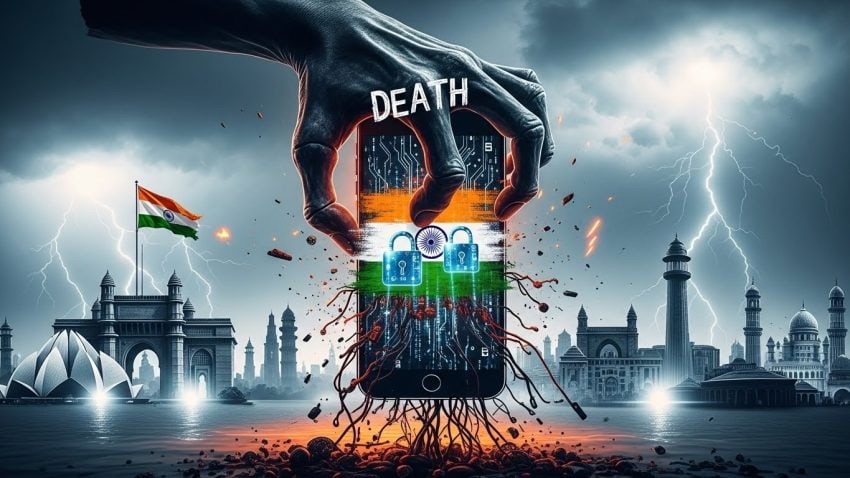
If one needs further proof that Narendra Modi’s government has shed the final vestiges of its democratic disguise, the latest edicts from New Delhi provide a terrifying confirmation. Under the guise of national security, India is systematically transforming the world’s largest democracy into the world’s most populous digital prison. The introduction of mandatory state-run spyware and demands for proprietary source codes marks a shift that rivals the darkest ambitions of totalitarian regimes. It is not just regulation; it is an Orwellian nightmare unfolding in real-time for 750 million smartphone users.
The measures announced are staggering in their audacity. First came the December 2025 mandate: within 90 days, every smartphone sold in India must come pre-loaded with the state-run Sanchar Saathi app. But this is not merely a utility tool. The government requires that this app cannot be disabled, restricted, or removed. It demands permissions to manage phone calls, read messages, access photos, and even control the camera.
Let’s call this what it is. When a government forces you to install software that can watch you, listen to you, and track you—software you are forbidden from deleting—that is not a security feature. That is a shackle. As the Internet Freedom Foundation correctly identifies, this mandate converts every smartphone into a vessel for state surveillance. It effectively places a government agent in the pocket of 1.2 billion mobile users.
The justifications offered by the BJP regime—combatting fraud and recovering lost devices—are flimsy at best. While recovering 700,000 lost phones is a neat statistic, does locating a stolen device require access to a citizen’s private photo gallery or the ability to make phone calls without their consent? These permissions are wildly disproportionate to the stated goal. They reveal the true intent: total information dominance over the citizenry.
But Modi’s drift into digital authoritarianism doesn’t stop at the user; it extends to the creators. The January 2026 proposal to force manufacturers like Samsung and Apple to surrender their source code and alert New Delhi to every major software update is a demand without precedent in the democratic world. It is corporate extortion disguised as cybersecurity. By forcing companies to expose their proprietary technology and intellectual property to a government with a documented history of data mishandling, India is creating a hostile environment that would be unthinkable in any other major economy.
The geopolitical company India now keeps is telling. By mandating pre-installed government software, New Delhi joins a small, exclusive club that includes Russia—which enacted similar laws in 2024—and China. This is not the behavior of a burgeoning liberal power; it is the hallmark of a paranoid security state. The comparison to North Korea is no longer hyperbole; it is becoming a technological reality. India already leads the world in internet shutdowns, having pulled the plug over 600 times since 2012 to silence dissent. Now, it seeks to own the devices themselves.
The resistance from tech giants is brewing behind the scenes, but the danger for the average Indian is immediate. An app that cannot be disabled is not voluntary. A regime that demands source code is not interested in security; it is interested in control. The facade of the “world’s largest democracy” has collapsed under the weight of its own insecurity. In Modi’s new India, privacy is dead, consent is irrelevant, and the state is watching every digital breath you take. The drift is over. Totalitarianism has arrived.