

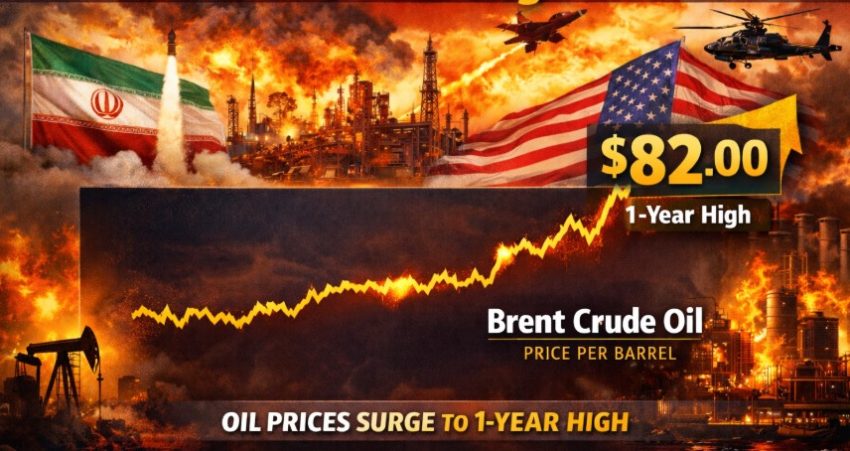
LONDON – Brent crude touched new heights, reminding the world that in today’s economy, conflict and commerce often move in the same breath.
The world’s energy markets were thrown into upheaval as oil prices rocketed at the start of trading on Sunday, fueled by war between US, Israel and Iran. Investors and energy experts warned that growing geopolitical instability could disrupt oil supplies and send fuel prices spiraling higher.
Traders reacted swiftly, betting that crude exports from the Middle East could slow, if tensions continue. Recent attacks on vessels in the vital shipping lanes of the Strait of Hormuz, a narrow and strategically critical waterway in the Persian Gulf, have intensified fears of supply disruptions. Nearly one-fifth of the world’s oil flows through this chokepoint, making it a cornerstone of global energy trade. Any restrictions on shipping could restrict access to crude and trigger sharp price hikes for consumers worldwide.
Benchmark crude, West Texas Intermediate, surged to around $72 per barrel on Sunday night with an 8% leap from Friday’s trading level of roughly $67. Energy analysts cautioned that if exports from the region are hampered, higher gasoline and fuel costs could follow as global supply tightens.
The stakes are high as around 15 million barrels of crude oil travel daily through the Strait of Hormuz, transporting energy from major producers including Saudi Arabia, Iraq, Kuwait, the United Arab Emirates, and Iran. Earlier in February, Tehran temporarily closed portions of the strait for military exercises, and further disruptions could exacerbate market volatility.
In a move aimed at calming concerns, members of the Organization of Petroleum Exporting Countries announced plans to boost production by 206,000 barrels per day in April, exceeding analysts’ expectations. Producers participating in the increase include Saudi Arabia, Russia, Iraq, the United Arab Emirates, Kuwait, Kazakhstan, Algeria, and Oman. However, energy experts warned that additional output may offer limited relief if shipping routes remain under threat.
Iran exports approximately 1.6 million barrels of oil daily, primarily to China. Any interruption to these flows could force buyers to seek alternative supplies, further tightening global inventories and driving prices higher.
‘Surrender or Die’: Trump warns Iran of more full-blown attacks after Khamenei’s Death