LONDON – Labour Party Leader Andy Burnham has officially become UK’s 59th Prime Minister as he pledged to restore stability, rebuild trust in politics, and reshape the economy through public investment and regional empowerment.
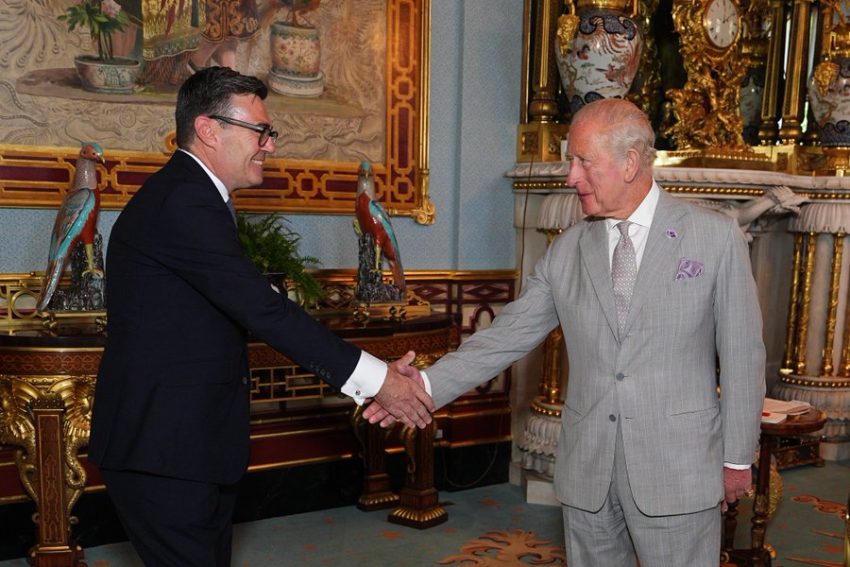
Burnham assumed office after King Charles III invited him to form a government at Buckingham Palace following Sir Keir Starmer’s exit. Labour Party elected Burnham as its new leader last week, with Home Secretary Shabana Mahmood confirming his unopposed victory during the party conference.
Delivering his first speech outside 10 Downing Street, Burnham acknowledged growing public frustration with politics and admitted that leaders had failed to meet expectations. “We haven’t done as good a job as we should have, and we need to be better,” he said, promising that his administration would mark a turning point for the country.
Calling stability the defining challenge of his premiership, Burnham said Britain must prove it can restore confidence in government while pursuing long-term economic renewal.
The new PM outlined ambitious domestic agenda centered on bringing essential public services back under public control to make them more affordable, supporting British industry, and encouraging a new phase of reindustrialization. He also announced that his government would publish a 10-year national plan later this year to set out its long-term vision for Britain’s future.
He argued that privatization and deindustrialization policies introduced during the 1980s had left lasting damage in many parts of the country. He pledged to replace political division with a more collaborative approach focused on solving practical problems rather than scoring political points.
A key pillar of his programme is devolving more powers from Westminster to local and regional authorities. Burnham said communities across England, Scotland, Wales, and Northern Ireland should have greater control over decisions affecting their own areas, describing decentralization as essential to reducing regional inequalities.
Addressing the ongoing cost-of-living crisis, Burnham announced that details of measures designed to provide financial relief for households would begin to be released from Tuesday, alongside information on how the initiatives would be funded. His policy agenda also includes reforming education to help more young people enter employment, expanding mental health support and other public services, and increasing the construction of council housing as a fair and sustainable way to reduce long-term welfare spending.
In one of the strongest commitments of his inaugural address, Burnham said his first directive as Prime Minister would be aimed at ending rough sleeping across Britain. He added that compassion, integrity, and high standards would guide every aspect of his administration. Closing his speech, Burnham urged the public to support his vision, saying he wanted this to be the moment “when Britain starts to believe again” and hope returns to the country.
Burnham’s appointment also marks symbolic milestone. Although Andrew Bonar Law served as Prime Minister in 1922, Burnham is the first occupant of 10 Downing Street to be popularly known as “Andy.” He is also the first Prime Minister since Harold Wilson to prominently embrace his northern identity as part of his political appeal.
Nicknamed “King of the North,” Burnham gained national prominence during the COVID-19 pandemic after publicly challenging the UK government’s handling of restrictions affecting Greater Manchester. His stand significantly raised his profile and reinforced his image as a champion of regional interests.
Born in Liverpool in 1970 and raised in Culcheth, Cheshire, Burnham joined the Labour Party at the age of 14 after being inspired by the television drama Boys from the Blackstuff, which highlighted unemployment and hardship in Liverpool. A lifelong Everton supporter, he studied English Literature at Cambridge University before beginning his career in journalism and later entering politics.
Burnham was elected to Parliament in 2001 and went on to serve in several senior ministerial roles under former Prime Ministers Tony Blair and Gordon Brown, including Chief Secretary to the Treasury, Culture Secretary, and Health Secretary.
He unsuccessfully contested the Labour leadership in 2010 and again in 2015 before leaving Westminster to become Greater Manchester’s first elected mayor in 2017. His decisive victories in the mayoral elections of 2017 and 2021 transformed him into one of Labour’s most influential political figures.