

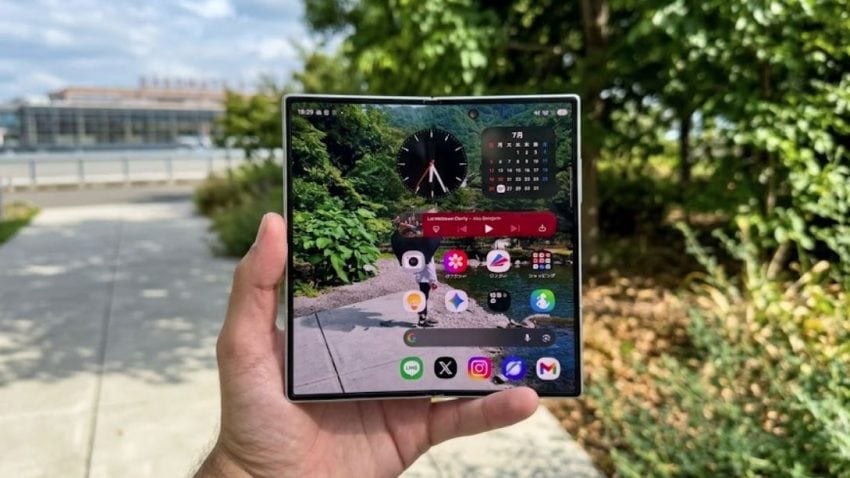
Foldable phones are said to be niche devices, especially in Pakistan, but Samsung takes foldables to the next level with passport-style Galaxy Z Fold 8, 200MP Ultra camera, silicon-carbon battery, and world-first smartwatch brightness, its launch in Pakistan remains uncertain as of now.
The company officially launched Galaxy Unpacked lineup, unveiling three new foldable devices with AI-packed features. The surprise of the event is Samsung’s dramatic shift in its foldable strategy. The company moved beyond incremental upgrades and introduced completely new direction for Galaxy Z Fold series, while also bringing major improvements to cameras, displays, batteries, durability, and software support.
Pakistani consumers may face uncertainty as Samsung has not confirmed whether these devices will officially arrive in the country, at least for coming weeks. A similar situation happened last year when Galaxy Z Fold 7 skipped an official Pakistani launch but still became highly popular in the local market.
With Samsung’s latest foldables expected to attract strong demand, buyers planning to import the devices may want to complete registration early, as the same situation could potentially repeat. Galaxy Z Flip 8 continues Samsung’s compact flip-phone concept but brings one major internal change as the company moved away from Snapdragon and introduced its own Exynos 2600 chipset.
Samsung Galaxy Z Fold 8 #samsunggalaxyzfold8 #samsunggaalxy #samsung #Fold pic.twitter.com/bDCUbV4Hpa
— SmartOS Thailand (@SmartOSThailand) July 28, 2026
Galaxy Flip 8 is only foldable model in the new lineup powered by Exynos, while Samsung has equipped the larger Fold models with Snapdragon processors. Although the overall design remains similar to the previous generation, Samsung has refined the build quality and improved display performance. The biggest upgrade comes to the cover display, which now works much closer to a full smartphone screen. Users can perform significantly more tasks without unfolding the phone, thanks to improved foldable optimization in Android 17.
Samsung is essentially turning the outer display from a secondary panel into a more practical everyday screen.
For years, Samsung’s Fold lineup followed a tall book-style design. But this year, the company has completely changed direction by introducing a passport-style foldable form factor. The move shows shift in Samsung’s strategy, as the traditional Fold experience now moves toward the Ultra category, while the standard Galaxy Z Fold 8 adopts a wider design.
Samsung Galaxy Z Fold 8 Price
The Samsung foldable smartphone is available in three storage variants, all paired with 12GB RAM. The base model comes with 256GB storage and is priced at $1,899.99. The mid-tier version doubles the storage to 512GB while keeping 12GB RAM, with a price tag of $2,099.99. The highest-end variant offers 1TB of storage with 12GB RAM and is listed at £2,209.00. As storage capacity increases, the price also rises, giving users more space for apps, photos, videos, and files.
| Storage | RAM | Price |
|---|---|---|
| 256GB | 12GB RAM | $1,899 |
| 512GB | 12GB RAM | $2,099 |
| 1TB | 12GB RAM | £2,209 |
Samsung has also boosted display brightness from 2,600 nits to 3,000 nits and improved the anti-reflective coating, making the screen easier to view in bright environments. However, the camera story is also interesting. Galaxy Z Fold 8 comes with a 50-megapixel main camera, replacing the previous 200-megapixel sensor. Samsung has reserved its highest-resolution camera technology for the premium Galaxy Z Fold 8 Ultra.
The device features a 4,800mAh battery, 45W fast charging support, and a simplified rear camera system after removing the dedicated 10-megapixel telephoto zoom lens. While the Galaxy Z Fold 8 introduces a new design direction, the Galaxy Z Fold 8 Ultra represents the true successor to last year’s flagship Fold model.
Samsung has packed the Ultra variant with flagship-level camera hardware, including 200-megapixel primary camera, 50-megapixel ultra-wide shooter and 10-megapixel telephoto zoom camera. The biggest technological change is the introduction of silicon-carbon battery technology for the first time in Samsung’s foldable lineup.
Although the battery capacity remains at 5,000mAh, silicon-carbon technology allows manufacturers to achieve better battery performance in a smaller space. The move is significant because Samsung had remained extremely cautious with battery innovation following the Galaxy Note 7 battery crisis.
The company has also improved charging capabilities with 45W wired charging, 20W wireless charging and reverse wireless charging. Both the Galaxy Z Fold 8 and Fold 8 Ultra feature titanium hinges, which Samsung claims improve durability and make the fold crease less noticeable.
Artificial intelligence is another major focus of Samsung’s latest devices. The upgraded Now Brief feature can now understand user requests and suggest relevant images automatically. Samsung also expanded Google Gemini AI integration across its own applications, including improvements to Samsung Notes.