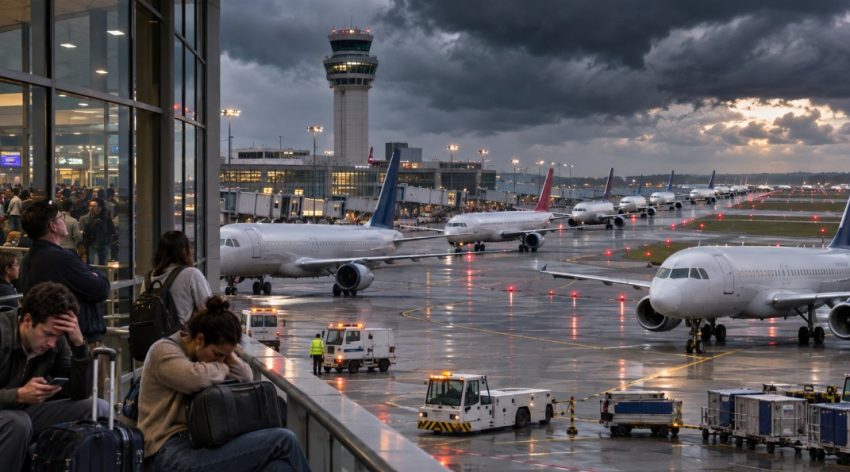
WASHINGTON – US aviation network faced chaostic scenes due to a massive technical breakdown, which forced authorities to ground flight across the country for more than four hours. Although flights have started moving again, US officials warn that the disruption could take days to clear.
One of the world’s busiest aviation networks was brought to a sudden standstill when the Federal Aviation Administration (FAA) issued extraordinary nationwide ground stop, citing serious safety concerns and unusual circumstances. The sweeping restrictions prevented aircraft from taking off at airports across the United States, triggering widespread disruption and leaving travelers stranded as officials scrambled to identify the problem.
At 20:54 UTC, the FAA issued a nationwide ground stop for all flights departing for US airports due to an equipment outage. At the time, 4,042 flights destined for US airports were already airborne. Watch the next two hours of US air traffic. https://t.co/qbtzX7cMtc
— Flightradar24 (@flightradar24) November 13, 2026
FAA published emergency notice on its website before removing it. The exact number of flights affected was not immediately known. A flight-tracking service reported that around 3,100 aircraft were already flying over the US when the shutdown began. Those planes continued toward their destinations, but fresh departures were halted.
The crisis also affected passengers whose planes had already landed, with some reporting that aircraft were being held on airport tarmacs instead of being allowed to proceed to terminal gates. Several major airports confirmed the suspension and urged travelers to check directly with their airlines before leaving for the airport.
What is behind US Flight Shutdown?
The extraordinary aviation emergency was traced to a major communications failure affecting air traffic control centers across the country. US Transportation Secretary Sean Duffy revealed that the malfunction had disrupted essential communications infrastructure, forcing aviation authorities to take immediate precautionary measures.
BREAKING: Transportation Secretary Sean Duffy CONFIRMS old, OUTDATED FAA hardware caused today’s nationwide communications outage that grounded flights across the country
“Our switches, our routers actually got overloaded with data and they went down. And I shouldn’t say they went down. They started to give us inconsistency in the data from those routers. And because of that, we shut the system down. Now, I have already replaced some of those switches with President Trump, and our new IP switches did not go down.”
“It’s the old hardware that went down. And I think the question for the American people is, do you want your Congress to fund this? President Trump has asked for the money. He’s asked the Congress on a bipartisan approach to say, give us the resources to build a state-of-the-art air traffic control system.”
— RedWave Press (@RedWavePress) November 14, 2026
FAA confirmed that a temporary telecommunications outage was responsible for the nationwide restrictions, while international flights were being assessed individually. As technicians worked to restore services, the scale of the disruption raised questions about the reliability of America’s aviation infrastructure.
During a White House briefing, Duffy disclosed that the problem had originated in aging equipment rather than newly installed technology. According to him, the old network had been operating under excessive pressure, with temporary arrangements placing additional strain on critical systems.
Technical teams eventually managed to ease the burden on network switches and reactivate the communications network. The transportation secretary acknowledged that the failure had caught authorities by surprise, warning that outdated infrastructure could trigger similar breakdowns in the future.
Flights Resume After 4-Hour Ground Stop
After more than four hours of uncertainty, American authorities announced that the emergency restrictions had been lifted and flight operations could gradually restart.
Officials confirmed that the nationwide ground stop officially ended at 8:15pm US time, allowing airlines to begin restoring their schedules. However, reopening the airspace did not mean an immediate return to normal.
The transportation secretary explained that air traffic control centers and Terminal Radar Approach Control facilities, known as TRACONs, were operational again, but airlines would have to adjust departures and arrivals according to available resources. The sudden shutdown had created a ripple effect throughout the aviation network, making it difficult to restore normal operations simultaneously at every airport.
Officials began assessing flight movements, airport capacity and the wider operational backlog as airlines worked to get stranded passengers moving again. Duffy warned that travel disruption could continue for several days, even though the main technical problem had been resolved.
Is there a Cyberattack behind US Flight Shutdown?
Amid growing concerns about the cause of the nationwide emergency, senior American officials moved to dismiss speculation about a possible cyberattack. Homeland Security Secretary Mark Van Mullen told reporters at the White House that investigators had found no evidence of malicious cyber activity.
He also rejected suggestions that the outage was connected to the Microsoft system failure reported the previous day. Attempting to reassure the public, Van Mullen stressed that the emergency was not comparable to the September 11 attacks. He maintained that passenger safety had never been compromised during the disruption.
Special investigation teams have nevertheless been assigned to examine the incident and determine how the communications network suffered such a widespread failure. Officials said the initial findings pointed toward technical weaknesses in existing systems rather than an external attack.
The shutdown has brought renewed attention to the condition of America’s air traffic control network, with officials openly acknowledging that critical infrastructure is increasingly outdated. Officials admitted that authorities could not predict every catastrophic network failure, particularly while relying on aging equipment.
He warned that similar incidents could occur unless the government moved forward with a comprehensive modernization program.
During White House briefing, journalists challenged Duffy over the safety of air travel, asking why passengers should have confidence in a system that the transportation secretary himself considered obsolete. Rather than directly addressing that concern, Duffy emphasized the urgent need for Congress to approve funding for a new air traffic control network.
Both Duffy and Van Mullen argued that insufficient congressional funding had delayed essential improvements to the country’s aviation infrastructure.
Van Mullen went further, warning that the transportation system required a major overhaul to prevent a repeat of the crisis. Despite the enormous scale of the proposed modernization effort, Duffy insisted that further delays were no longer acceptable.
With the immediate emergency over, attention has shifted to how quickly airports and airlines can recover from the nationwide shutdown. Duffy acknowledged that resolving the backlog and restoring the system’s full capacity would require time.
He expressed confidence, however, that the aviation network could return to full operational strength before the Thanksgiving holiday. Authorities are now working to restore disrupted flight schedules, assist affected passengers and ensure that air traffic control services remain stable.
Flights from Pakistan to Saudi Arabia, Bahrain and UAE delayed, cancelled amid fresh tensions