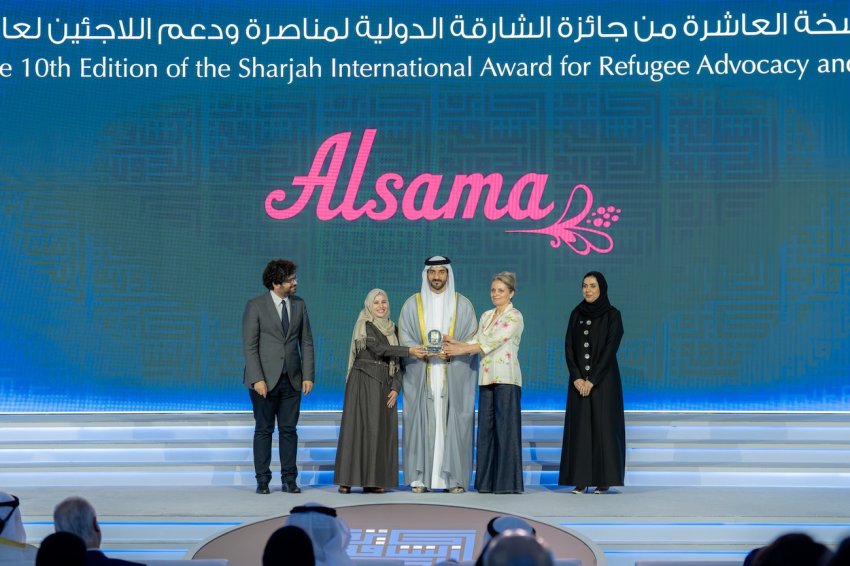
SHARJAH – Lebanon’s Alsama Project on Wednesday won the 10th Sharjah International Award for Refugee Advocacy and Support for helping young refugees return to school after displacement interrupted their education.
Sharjah Deputy Ruler Sheikh Dr Sultan bin Ahmed Al Qasimi presented the AED500,000 award at the Al Jawaher Reception and Convention Centre. The project was selected from 736 nominations across 57 countries.
Alsama runs a six-year accelerated programme that enables students who enrol without being able to read or write to reach the equivalent of Grade 12 and apply to university.
The Big Heart Foundation organises the award in partnership with the UN refugee agency, UNHCR. Established in 2017, the award has drawn more than 3,000 nominations from nearly 70 countries and recognised organisations working in education, healthcare, protection, social inclusion and livelihoods.
From Shatila camp to university
Alsama began working with 40 Syrian refugee girls in Beirut’s Shatila camp in 2020. It now operates five education centres in Beirut and the Syrian city of Homs. According to the project, 90 per cent of students could neither read nor write when they enrolled, and most acquired basic literacy within six months.
At the ceremony, co-founder Kadria Hussein recalled the experience of Wissal, a student from rural Deir ez-Zor in Syria whose schooling was disrupted by war and displacement. Wissal could neither read nor write when she joined the Shatila centre in 2020. Six years later, she graduated and moved to Canada to study psychology at York University.
Of the 16 Alsama graduates who have gone on to higher education, 13 have enrolled at universities in Canada, the United Kingdom, India and Lebanon. Three are continuing their studies online through Cambridge PACE.
UNHCR Assistant High Commissioner for Operations Antón Leis García called for sustained support for organisations working directly with refugees. He said the agency’s partnership with The Big Heart Foundation had helped more than one million displaced people across Africa, Europe and Asia access services including education, healthcare and shelter.