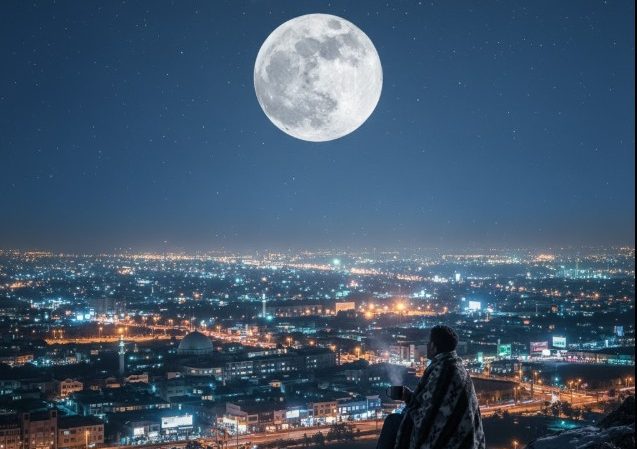
ISLAMABAD – World braces for Wolf Supermoon as moon is set to get more brighter and larger than usual, as if the Moon itself is leaning in to say hello.
The moon light is likely to be shimmer a little more, thanks to Earth being closer to the Sun, and the crisp winter air will make every detail sparkle. Just look up, wrap yourself in a blanket, and watch the night sky put on a show you won’t soon forget. Skywatchers in Pakistan are in for a spectacular treat as the first supermoon of 2026, known as Wolf Moon, will grace the night skies on January 3 and 4, the Space and Upper Atmosphere Research Commission (Suparco).
A supermoon occurs when the moon comes closest to Earth in its elliptical orbit, making it appear dramatically larger and brighter than a typical full moon, sometimes up to 14% bigger and nearly 30% more luminous.
“In Pakistan, the Wolf Moon will rise at 5:51 pm PKT on January 3 with 99.8% illumination and will remain visible throughout the nights of January 3 and 4,” Suparco said.
This event marks final supermoon of cycle that started in October 2025. During peak, the moon will be about 362,312 kilometers from Earth, appearing 6–7% larger and up to 10% brighter than a normal full moon, a breathtaking sight for astronomers, photographers, and skywatchers alike.
Supermoons typically appear in sequences of three to four consecutive events. This current cycle concludes with the Wolf Moon, while the next sequence is expected to start in November 2026.
In 2025, Pakistan witnessed three supermoons: the first on October 7, followed by the Beaver supermoon on November 5, and the final supermoon of the year on December 4–5, lighting up the country’s skies and mesmerizing observers.
Pakistan witnesses spectacular year’s biggest and brightest supermoon