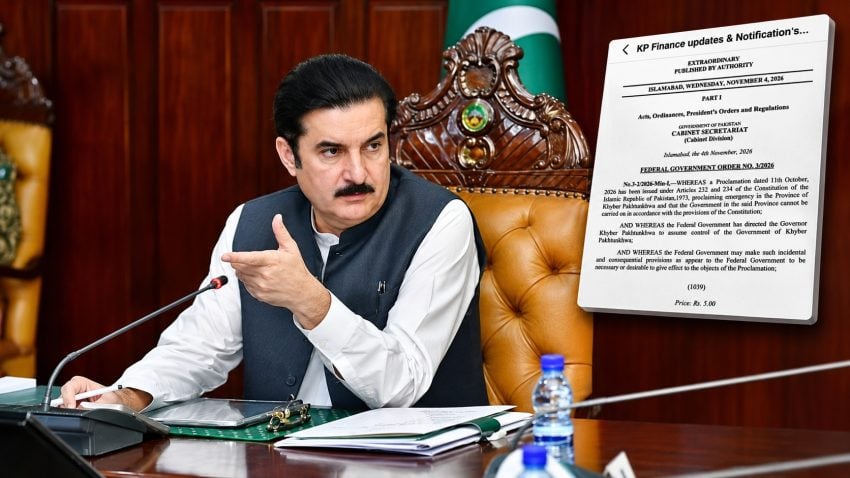
ISLAMABAD – The federal government tightened its grip on Khyber Pakhtunkhwa, handing sweeping executive authority to Governor after centre’s takeover of province under emergency rule.
The federal government formally transferred powers of the chief minister to Governor Faisal Karim Kundi, effectively placing the province’s executive machinery under his command. The extraordinary decision, announced through official gazette notification issued by the Cabinet Division on November 4, comes amid an increasingly tense political confrontation between the federal government and Pakistan Tehreek-e-Insaf (PTI), which previously controlled the provincial administration.
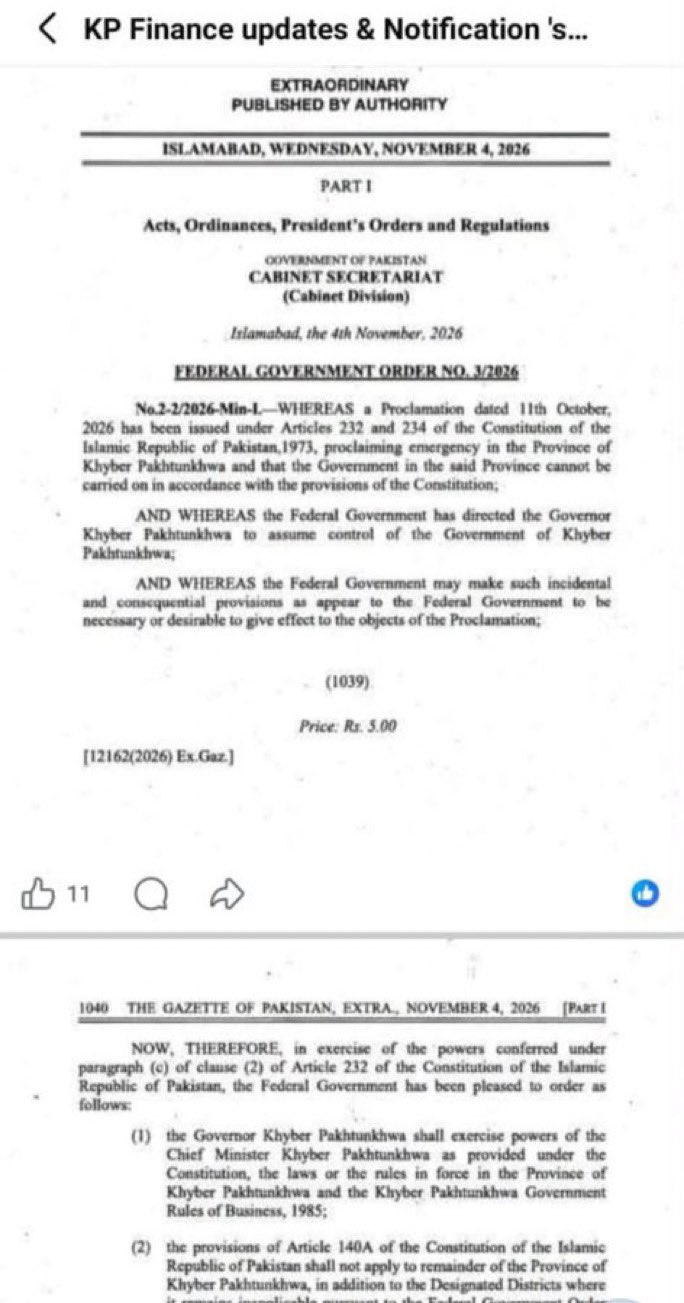
Under Federal Government Order No. 3/2026, the governor has been authorised to exercise the chief minister’s powers under the Constitution, provincial legislation and the Khyber Pakhtunkhwa Government Rules of Business, 1985. The order has taken immediate effect, formalising a fundamental shift in the province’s executive authority.
The notification establishes a new administrative arrangement under which the governor assumes responsibilities previously entrusted to the elected chief minister. His authority extends to powers provided under the Constitution, provincial laws and relevant administrative rules, giving him a central role in running the provincial government during the emergency.
The move completely sidelines PTI-led provincial government, previously headed by Chief Minister Sohail Afridi, deepening the political crisis surrounding the province’s constitutional future.
The latest development follows the federal government’s decision to impose emergency measures in Khyber Pakhtunkhwa on October 11, 2026, under Articles 232 and 234 of the Constitution. The emergency proclamation said that the provincial government could no longer be administered in accordance with constitutional requirements, providing the basis for extraordinary federal intervention.
President Zardari approved emergency measures on the advice of Prime Minister Shehbaz Sharif, paving the way for the governor to assume control of provincial affairs. The federal government linked its intervention to deteriorating security conditions, increasing militant violence and concerns over the provincial administration’s ability to maintain law and order.
Under the arrangement, the governor is required to provide monthly reports to Islamabad detailing the exercise of his newly assigned responsibilities. An advisory council has also been established to assist the governor in overseeing provincial matters, while the federal government has maintained that the exceptional measures are intended to improve governance and restore stability.