
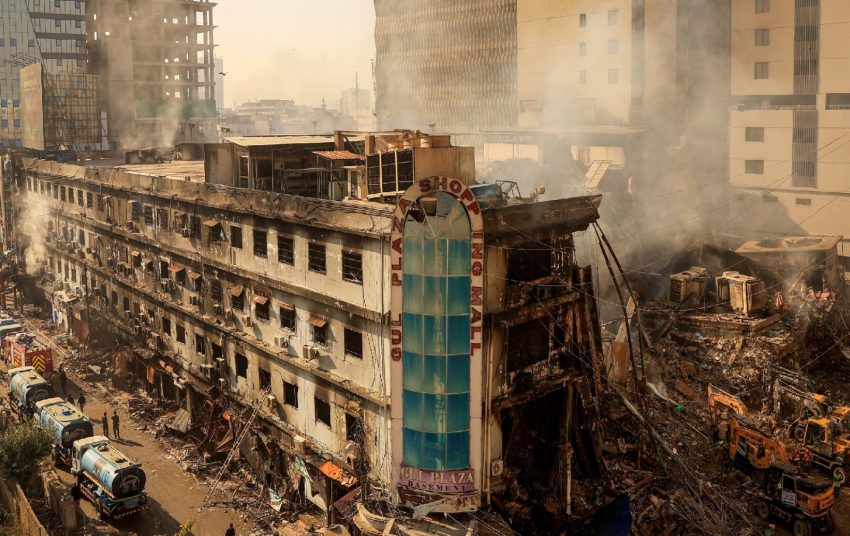
I am trying to find the words to describe the Gul Plaza tragedy, but honestly, it’s hard. My hands are shaking as I type. I can’t stop crying. Six days later, and the air still stinks of grief. This plaza was the beating heart of Karachi’s trade—three floors, 1,200 shops, constantly alive. Now, I’m looking at a graveyard of twisted metal and ash. It breaks you just to see it. Everything is gone. Nothing is left but questions and ghosts.
At the time of writing, 75 people have been declared dead. Many more are still missing, with no hopes left, unfortunately, for them to remain alive after 6 days. They remain buried under the twisted metal and concrete that was once their livelihood.
Gratitude needs to go where it was earned on that street. I saw the incredible grit of the Rescue 1122 teams, leading the operation from the front while everything else was falling apart. When the fire trucks ran dry, backup arrived fast: the Navy, Pakistan Army, PIA, and Civil Aviation Authority all deployed their assets to battle the inferno. And holding the chaos together were the Sindh Rangers. They secured the area, kept the onlookers safe, and protected the survivors pulling themselves out of the smoke. These men gave everything. We owe them.
But now, the rescue phase is ending, and the reckoning must begin. While we bury our dead, my mind is screaming a singular question: Who turned Gul Plaza into a death trap?
The facts are damning. This plaza had 26 potential exit points. When the fire broke out, only two doors were open. Let that sink in. Out of 26 ways to live, 24 were sealed shut.
A detailed analysis indicates there were at least 16 main exits, yet barely two or three were operational. Why? Because greed blocked the way. Illegal shops were constructed over pathways, turning emergency routes into commercial real estate. Who locked those doors? Who allowed storefronts to be built over the very paths meant to save lives? When the thick black smoke descended and the lights went out, hundreds of people found themselves clawing at walls where doors should have been. The people of Karachi demand an answer.
That isn’t an accident. That is murder by negligence.
Where were the safety inspections? Gul Plaza had no functional fire alarms. No sprinkler systems. No extinguishers. This building was a ticking time bomb loaded with highly flammable materials—toys, plastics, luggage—all stored without a single safeguard. The plaza was approved for roughly 1,000 shops but housed over 1,200. Every unauthorized addition narrowed an escape route. Every inch of illegal wiring increased the risk of a blaze. And yet, the Sindh Building Control Authority (SBCA) and KMC watched in silence.
We all know why. Corruption allowed these violations to be “regularized” with bribes. Officials didn’t check for compliance; they checked for envelopes. And the price for those bribes has now been paid in human lives.
Then there is the criminal failure of infrastructure. As the fire raged, brave firefighters stood helpless because their trucks ran dry. Why was the nearest functional hydrant at Nipa Chowrangi—an agonizing hour away through Karachi’s broken traffic? Why were there no standby water tanks? Outside the plaza, the roads are dug up for the never-ending Green Line bus service construction, leaving no emergency lanes for ambulances. The city administration didn’t just fail to put out the fire; they failed to even pave the road to get there.
The finger points directly at the Sindh Government and the City Administration. The Mayor and Chief Minister, who arrived late to the scene, preside over a system where safety audits are non-existent and fire drills are a foreign concept. They manage a city of millions like a medieval fiefdom, devoid of modern disaster management protocols.
The first responders—Rescue 1122, the Rangers, the Armed Forces, and aviation teams—did their absolute best. But they cannot fix a broken system; they can only pull bodies out of it.
Yet, in this tragedy, the heart of Karachi still beats. While the government hesitates, the people have stepped up. The losses at Gul Plaza must be compensated immediately; with Ramadan approaching, these traders cannot afford delays. They need an alternative marketplace now. It is heartening to see civic leaders filling the void left by the state—ARY News President Salman Iqbal has pledged 5 billion rupees to support the management and victims, while iconic commercial hubs like Dolmen Mall and Atrium Mall have offered free retail space to displaced shopkeepers. Karachi’s people are truly the best; they always rush to help their own. But it begs the question: where is the Sindh Government in all of this? If private citizens can mobilize billions overnight, why is the provincial treasury silent?
So, who will take responsibility? Who signed off on the illegal shops? Who pocketed the money meant for hydrant maintenance? Who decided that profit was more important than fire exits? Karachi doesn’t need another committee or another condolences tweet. We need names. We need trials. And we need an answer to the families who are still standing outside the ruins, waiting for loved ones who were trapped behind doors that should never have been locked.
Gul Plaza Fire: Death Toll rises to 30 as search operation continues on Day 5