
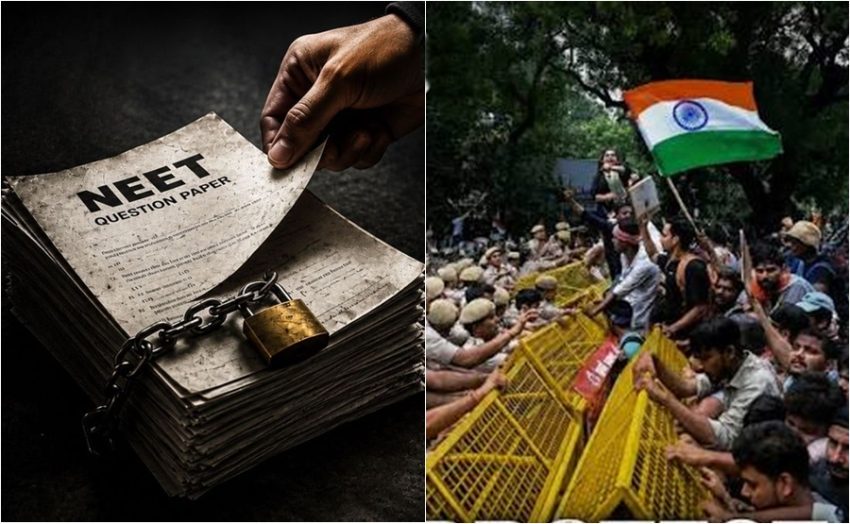
The NEET paper leak snowballed into one of India’s biggest education controversies, triggering massive student protests at Delhi’s Jantar Mantar and sparking nationwide outrage over the integrity of competitive examinations.
The scandal intensified political pressure on the government, with the controversy eventually leading to the resignation of India’s Education Minister Dharmendra Pradhan as demands for accountability and sweeping reforms dominated the national debate.
It began as a single student’s complaint, which made explosive examination controversy that rocked Delhi. The alleged operation stretched from a printing press in Maharashtra to Rajasthan, Haryana and Kerala, exposing what critics describe as a sophisticated paper leak gang that compromised one of India’s most important entrance examinations.
The conspiracy reportedly started at a printing press in Nashik, where two alleged masterminds from Jaipur are accused of obtaining the confidential examination paper. Investigators claim the paper was then routed to a doctor in Gurugram, Haryana, who allegedly served as the middleman before passing it to a consultancy firm in Sikar, Rajasthan.
From there, an alleged WhatsApp network operating under name “KA400” became hub for distributing leaked examination papers across India. Reports claim candidates were charged anywhere between INR 30,000 and INR 500,000 for access to the paper, while one buyer from Nagaur allegedly paid INR 2.8 million.
The alleged leak reportedly reached Kerala, where photocopies of the paper were said to have been sold inside student hostels. When candidates appeared for the NEET examination on May 2, many were stunned after discovering that around 90 percent of the Biology questions and 45 percent of the Chemistry questions allegedly matched the leaked paper circulating before the exam.
The breakthrough reportedly came when a candidate from Kerala refused to remain silent. After alleging that local police dismissed the complaint, the student emailed the National Testing Agency (NTA), triggering a chain of events that eventually reached India’s Intelligence Bureau (IB).
The agency forwarded information to Rajasthan’s Special Operations Group (SOG), whose investigation allegedly exposed the wider network and sent shockwaves through the country. NEET is India’s gateway to admissions in medical, engineering, aviation and several other professional disciplines, with nearly 2.2 million students competing each year. The allegations have intensified concerns over the integrity of one of the country’s most competitive examinations, with opposition leaders and student groups questioning whether deserving candidates were denied a fair chance.
The controversy fueled nationwide protests and renewed demands for accountability, while critics continue to accuse the government of failing to safeguard the examination process.
Chaos in Delhi as Cockroach Janta Party Protest sparks Internet Shutdown, Baton Charge