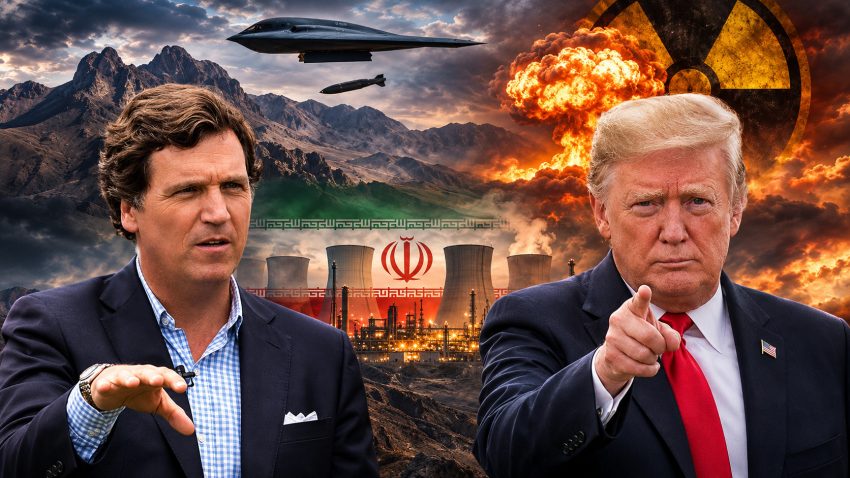
WASHINGTON – Deep beneath Iran’s rugged mountains lies Pickaxe Mountain, a heavily fortified nuclear facility now at centre of new controversy as American commentator and journalist Tucker Carlson claimed that US President Donald Trump could consider nuclear strike on the underground complex by November 7, allegedly under pressure from Israeli Prime Minister Benjamin Netanyahu.
In a detailed post, Carlson suggested that a decision could emerge as early as November 7, raising fears that the months-long Middle East conflict could enter an unprecedented and potentially catastrophic phase. The allegations gets wide attention, particularly as Washington and Tehran remain locked in a dangerous confrontation over Iran’s nuclear programme.
Carlson has not shared verifiable evidence supporting the alleged nuclear strike plan, and neither the American nor Israeli government has publicly confirmed that such an operation is being prepared. At the heart of Carlson’s warning is underground Iranian nuclear-related installation known as Pickaxe Mountain, located near the Natanz nuclear complex in central Iran.
Under pressure from Israeli prime minister Benjamin Netanyahu, the Trump administration may be within days of launching a nuclear strike on Iran. The target would be Pickax Mountain in central Iran, where Israeli intelligence claims the Iranian government has restarted its nuclear enrichment program. No conventional weapon in the American arsenal can penetrate 300 feet of solid granite to destroy the tunnels where enrichment is supposedly taking place. The only military option is a nuclear strike. Netanyahu has been pushing hard for one. “Bibi calls Trump about it every day,” says an informed observer.
Netanyahu is cornered and desperate. After last week’s election results, he can’t form a government unless Trump intervenes directly in Israeli politics and brokers a deal with other parties that gives Netanyahu 61 seats in the Knesset. Otherwise, he is out as prime minister and on his way to ignominy, investigations and possibly jail. Netanyahu must stay close to Trump. He needs this war.
To that end, he’s applied maximum pressure to his closest allies in the administration, including Secretary of Defense Pete Hegseth and CENTCOM commander Brad Cooper. Both oppose a negotiated settlement to the war they’ve so grievously mismanaged; both are pushing to restart major combat operations. Secretary of State Marco Rubio and CIA director John Ratcliffe are also following Netanyahu’s lead, as are leaders of the Democratic Party. In a recent meeting on the subject, former president Barack Obama said he opposes the current Iran peace deal being drafted in Doha.
The rest of America’s longtime allies in the Middle East are terrified by the prospect of more war. On September 27th, Netanyahu flew secretly to Abu Dhabi to enlist the UAE in his lobbying effort for a final attack on Iran. The Emiratis refused. After eight months of conflict, Gulf economies are teetering. So are global energy and fertilizer markets. They won’t recover soon. Globally, there are a total of about 850 supertankers used to transport oil from producers to the rest of the world. In October alone, 11 of them were badly damaged in Hormuz. At this pace, a global depression is imminent. A nuclear strike would radically accelerate the destruction. Fallout from a ground explosion at Pickax Mountain would contaminate the Persian Gulf, poisoning the water supply for 100 million people.
And those are just some of the immediate consequences for the region. The rest of the world is every bit as exposed. No country other than the United States has ever used a nuclear weapon in war. Some would like to. An American nuclear attack on Iran would set a new precedent. The Russians have already told at least two other governments that an American nuclear strike on Iran would free them to use nuclear weapons against Ukraine. Pakistan and India would be tempted to do the same against each other, as would North Korea against Seoul. After the first nuclear strike, World War Three is inevitable. That war would be short and final.
We’ve been sleepwalking toward this moment for months. Since February, the administration has quietly rewritten America’s nuclear doctrine to make first use of so-called “battlefield nukes” easier and therefore more likely. No one in Washington in either party seems bothered by this. Now we’re on the brink of it.
Close observers say Trump is likely to decide by next weekend whether or not to use nuclear weapons. That would be November 7, six days from now. To his credit, he’s hesitating. At the moment, Trump is listening to his vice president, JD Vance, and to his envoy and friend Steve Witkoff, both of whom argue a deal with Iran can be made.
They’re right, though it won’t be simple. The Iranians are famously frustrating to negotiate with under any circumstances, and elements of that government have become more radical since Ayatollah Ali Khamenei and his family were killed in February. After decades of isolation, even relatively moderate Iranian leaders seem confused by how decisions are made in the West. (There is a widespread belief in Tehran, for example, that the United States government controls Israel.) But overall, people who have spoken to decision-makers in Iran say there is consensus there that more war is bad for everyone and a deal is worth making.
One group that hasn’t been consulted so far is the global population — the hundreds of millions of people who will be killed along with their children if Trump is pushed by Netanyahu into launching a nuclear strike next week. Now would be the time for them to speak up.
— Tucker Carlson (@TuckerCarlson) November 2, 2026
The heavily fortified facility, also identified as Kuh-e Kolang Gaz La, is believed to house tunnels extending more than 300 feet beneath mountainous terrain. Construction reportedly began some 7-8 years back, with Iranian officials linking it with complex centrifuge production and assembly activities.
Israeli intelligence reportedly suspects that Tehran may have relocated sensitive nuclear equipment or enriched uranium to the underground site following previous military attacks.
Carlson went further, alleging that Israeli intelligence believes Iran has resumed uranium enrichment inside the complex. According to his assessment, the enormous depth and rock protection surrounding the installation make it exceptionally difficult to destroy using conventional American weapons.
United States possesses powerful bunker-busting bombs, including the GBU-57 Massive Ordnance Penetrator, but the ability of such weapons to completely destroy deeply buried chambers remains uncertain. Carlson argued that these limitations could push Washington toward considering a nuclear option.
Carlson placed Netanyahu at the centre of the alleged pressure campaign, suggesting that the Israeli leader has been intensifying efforts to persuade Trump to approve a devastating strike. Quoting an unidentified informed observer, Carlson claimed Netanyahu was contacting the American president daily over the issue.
Carlson suggested that the Israeli leader’s political survival could depend on Trump’s intervention. But there is no independently established evidence directly linking Netanyahu’s domestic political struggles to an effort to secure an American nuclear attack. Reports of recent Trump-Netanyahu telephone conversation also indicate that the Israeli leader has pressed for further conventional military action against Iran, while Washington has continued examining diplomatic possibilities.
Carlson also drew attention to Netanyahu’s reported private visit to Abu Dhabi on September 27, when he met UAE President Mohammed bin Zayed Al Nahyan. The visit itself has been reported, although claims concerning the precise nature of Netanyahu’s alleged requests remain unverified.
US Nuclear War Policy
Carlson also alleged that the Trump administration had been tweaking American nuclear strategy since February, making the potential first use of smaller tactical nuclear weapons more accessible. The claim triggered questions about whether Washington’s military establishment is preparing for a more aggressive nuclear posture.
Defense Secretary Pete Hegseth and other senior officials have been associated with broader discussions concerning American military readiness and strategic deterrence. Carlson also criticised influential figures across Washington, including Secretary of State Marco Rubio, CIA Director John Ratcliffe and senior military leadership, over their perceived approach to Iran.
His account additionally raised questions about opposition to diplomatic efforts among certain American political figures, including allegations involving former President Barack Obama and Democratic leaders. However, the specific claims of coordinated opposition to a negotiated settlement, or a secret nuclear doctrine rewrite designed to facilitate an Iranian attack, have not been independently substantiated.
Beyond the alleged military planning, Carlson issued an alarming warning about the potential humanitarian consequences of detonating a nuclear weapon against a deeply buried installation.
He claimed such an explosion could spread radioactive material across the Persian Gulf, potentially endangering drinking-water supplies relied upon by as many as 100 million people. The concern centres on the possibility of radioactive contamination affecting regional infrastructure, desalination facilities and the surrounding environment.
Nuclear War Scare grips Russia, Ukraine as Hackers push Fake Emergency Alerts