
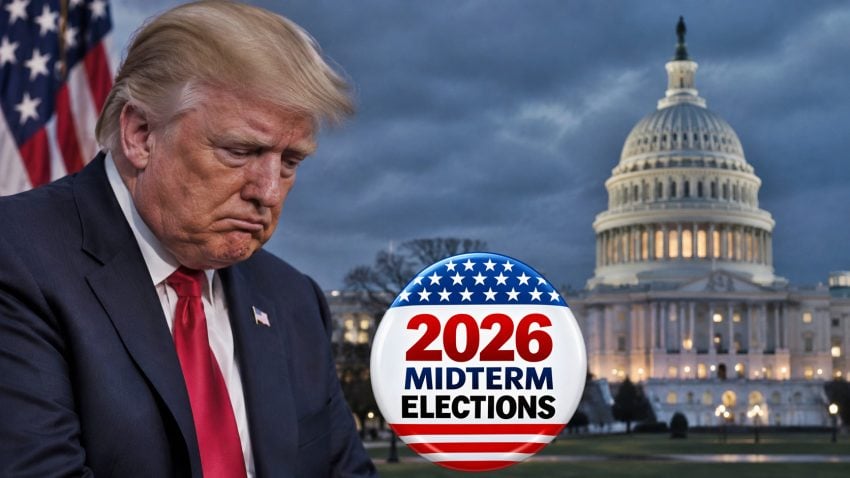
WASHINGTON (Daily Pakistan) – US President Donald Trump suffered political setback in US midterm elections as Democrats delivered victories in Republican strongholds, including Texas and South Carolina, while moving within striking distance of taking control of Congress.
Democrats broke decades of Republican dominance in crucial Senate contests, secured victories in North Carolina and Ohio, and made significant gains in the House of Representatives. The results show growing dissatisfaction with Trump’s administration, as American voters express mounting concerns over inflation, rising living costs, economic uncertainty and the direction of the country.
US Midterm Election Results 2026: Latest Updates
| Election | Latest reported position |
|---|---|
| Total House seats | 435 |
| Seats needed for House majority | 218 |
| Democrats — House | At least 208 projected |
| Republicans — House | At least 160 projected |
| House seats not covered by those projections | 67 |
| Senate seats contested | 35 |
| Total Senate seats | 100 |
| Senate majority threshold | 51 |
| Democratic Senate gains | 5 Republican-held seats reported flipped |
| Major Democratic Senate victories | Texas, South Carolina, North Carolina, Ohio |
| Trump’s early exit-poll approval rating | 38% |
| House control | Democrats closing in; final outcome not yet confirmed |
| Senate control | Still dependent on remaining races |
Democrats Close In on House Majority
The battle for the House of Representatives has emerged as one of the most consequential contests of the 2026 midterm elections. With all 435 seats up for election, Democrats entered the race needing a net gain of just three seats to overturn the Republicans’ narrow majority.
Before voting began, Republicans held 218 seats, alongside an independent who generally aligned with them, while Democrats controlled 214 seats and two remained vacant. As results emerged, Democrats made gains in several competitive districts, defeating Republican candidates and strengthening their prospects of crossing the 218-seat threshold.
Competitive races in Kentucky and New Jersey also attracted attention, with Democratic candidates Zach Dembo and Rebecca Bennett identified among those challenging Republican-held territory.
A Democratic takeover would end Republican control of the House and significantly weaken Trump’s ability to advance his domestic legislative agenda without opposition.
Texas Upset
Texas delivered one of the biggest political shocks of the election as Democrat James Talarico defeated Republican Ken Paxton in a historic Senate race. The victory represents the first Democratic statewide election win in Texas since 1994, breaking a Republican winning streak that had lasted more than three decades.
Talarico entered the final stages of the campaign with a narrow advantage, but his eventual victory transformed a closely watched contest into a landmark achievement for Democrats. The result carries enormous political importance because Texas is America’s second-most populous state and has traditionally been a central pillar of Republican electoral strength.
For Trump and his allies, losing such a politically significant state represents a particularly damaging outcome.
South Carolina Blow
Democratic wave also reached South Carolina, where Annie Andrews defeated Republican Darline Graham in a Senate contest that had initially appeared heavily favorable to Republicans. The result ended more than 20 years without a Democratic US senator being elected from the state.
Graham, whose candidacy had been supported by Trump, was appointed to the Senate following the death of her brother, longtime Republican Senator Lindsey Graham, earlier this year. Her defeat has intensified the political consequences of election night for the president, particularly because South Carolina had been considered a dependable Republican stronghold.
North Carolina
Former Governor Roy Cooper delivered another important victory by capturing a Republican-held Senate seat in North Carolina. Cooper defeated Republican Michael Whatley after maintaining a strong position throughout much of the election campaign.
Although opinion polls had suggested Cooper was likely to win, the result remains historically significant. Democrats had not won a Senate election in North Carolina since 2008, despite investing substantial campaign resources in the state over several election cycles.
Senate Election Results
| State | Democratic candidate | Status |
|---|---|---|
| Texas | James Talarico | Republican seat flipped |
| South Carolina | Annie Andrews | Republican seat flipped |
| North Carolina | Roy Cooper | Republican seat flipped |
| Ohio | Democratic candidate | Republican seat flipped |
| Georgia | Jon Ossoff | Democratic seat retained |
| Virginia | Mark Warner | Democratic seat retained |
| Delaware | Chris Coons | Democratic victory projected |
| New Hampshire | Chris Pappas | Democratic victory |
| Florida | Angie Nixon | Lost to Republican Ashley Moody |
| Maine | — | Closely contested at the reporting stage |
| Michigan | — | unresolved Senate contest |
| Minnesota | — | unresolved Senate contest |
The midterm elections have exposed mounting frustration among American voters over the country’s economic situation. Exit polling indicated that inflation, household expenses, economic uncertainty and concerns about democracy were among voters’ biggest priorities.
Trump’s approval rating stood at approximately 38% in early exit polling, highlighting the difficult political environment facing Republican candidates. The administration’s economic policies, including tariffs, and rising energy prices following the war with Iran also became major campaign issues.
If Democrats secure the House majority, they would gain substantial authority over congressional investigations, legislative committees and government oversight. They could use that power to examine decisions made by the Trump administration, scrutinize federal spending and challenge controversial policies. A Democratic majority could also make it more difficult for Republicans to pass major legislation.