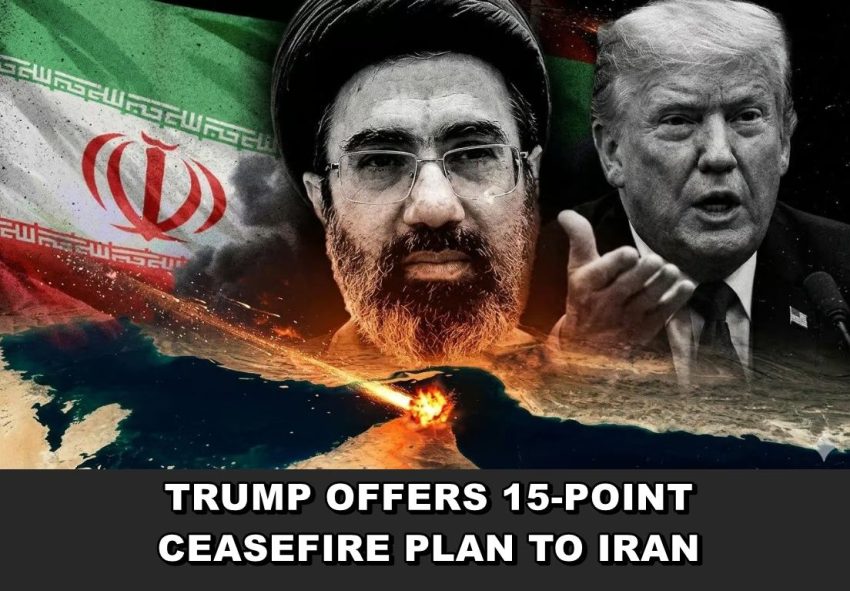
WASHINGTON – As intense military escalation enters fourth week, United States comes toward ceasefire and delivered 15-point proposal to Iran aimed at ending the rapidly escalating Middle East war.
The plan, reportedly sent through Islamabad, reveals Washington’s urgent push to find way out of a conflict that has already drawn in UAE, Saudi, Kuwait and multiple countries. But, uncertainty looms as it remains unclear whether Iranian leaders will accept the proposal.
US Proposal for Talks with Iran
One-month ceasefire
The proposal starts with a temporary 1-month ceasefire in hostilities in bid to stop ongoing violence and create a stable environment where diplomatic discussions can take place.
Nuclear Program Restrictions
Dismantling nuclear capability
Iran would be required to fully eliminate infrastructure associated with developing nuclear weapons. This goes beyond limiting activity and involves removing the underlying systems entirely.
Full stop on Nukes development
Iran would formally agree to abandon any plans or intentions to develop nuclear weapons, turning this into an official long-term policy stance.
End of uranium enrichment
All uranium enrichment activities would be stopped. Since enrichment is a key step in producing nuclear weapons material, halting it significantly reduces nuclear breakout potential.
Transfer of nuclear materials to international control
All nuclear materials would be placed under the supervision of the International Atomic Energy Agency to ensure transparency, monitoring, and safe handling.
Closure of key nuclear facilities
Major nuclear sites such as Natanz, Isfahan, and Fordow would be shut down to prevent further development of nuclear capabilities.
Unrestricted international inspections
International inspectors would be granted full and continuous access to nuclear sites. This would allow ongoing verification that Iran remains in compliance with the agreement.
Regional Influence
Ending support for proxy groups
Tehran would be expected to cease backing allied armed groups operating in other countries, which are often viewed as extensions of its regional influence.
Stopping funding and training of proxies
Financial, logistical, and military support to such groups would be discontinued, reducing Iran’s indirect involvement in regional conflicts.
Keeping the Strait of Hormuz open
Iran would ensure that this vital global shipping route remains open and secure for uninterrupted oil and gas transport, helping stabilize global energy markets.
Limiting missile development
Iran’s ballistic missile program would face phased restrictions, reducing its ability to develop long-range offensive strike systems.
Defensive-only military posture
Iran’s military capabilities would be limited to defensive purposes, restricting offensive or power-projection operations.
Economic Incentives
Lifting of economic sanctions
International economic and financial sanctions imposed on Iran would be fully removed, allowing it to re-engage in global trade and financial systems.
Support for civilian nuclear energy
Iran would still be permitted to pursue nuclear energy for peaceful purposes, with support for civilian projects such as Bushehr under international oversight.
Removal of the snapback sanctions
Mechanisms that allow sanctions to be quickly reinstated in case of violations would be permanently eliminated, providing Iran with long-term economic assurance.
Even as diplomacy intensifies, war machines are still in motion. White House confirmed negotiations are being explored, but made it clear that military operations, under “Operation Epic Fury,” are continuing without pause.
Despite the diplomatic push, US is ramping up its military presence. Around 2,000 troops from the elite 82nd Airborne Division are being deployed to the region, ready to respond at a moment’s notice.
Field Marshal Asim Munir dials Donald Trump in major push for US–Iran Peace Talks