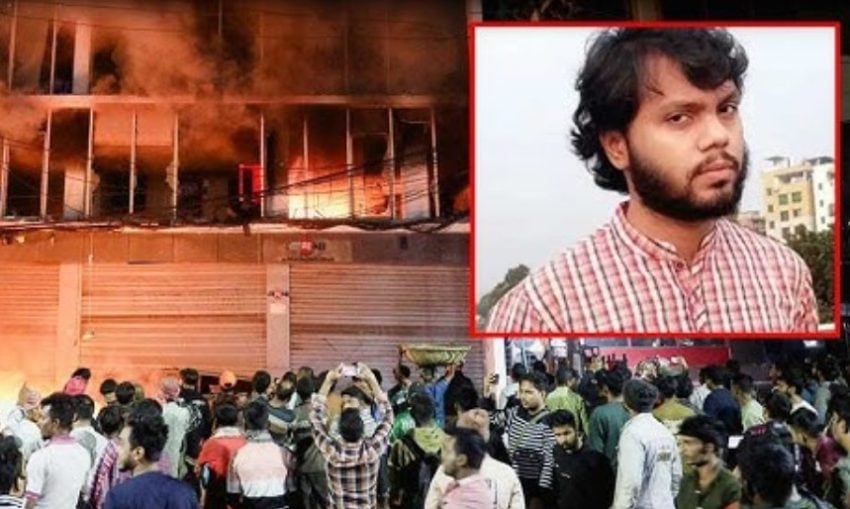
DHAKA – Bangladesh has been plunged into turmoil after death of Sharif Osman Hadi, a youth leader of political organization who played key role in toppling former Prime Minister Sheikh Hasina Wajed’s government.
Osman’s death ignited violent protests, arson, and attacks on media houses in the capital, prompting the interim government to declare a one-day national mourning. Hadi was shot last week in Dhaka as he stepped out of a mosque.
According to witnesses, unknown gunmen with covered faces opened fire before fleeing the scene. Critically injured, Hadi was rushed first to Dhaka Medical College Hospital, then shifted to a private hospital, and later flown to Singapore for advanced treatment. Despite days of medical intervention, he succumbed to his injuries on Thursday.
The assassination occurred just one day after the interim government announced date for general elections, the polls Hadi himself planned to contest as an independent candidate, raising serious questions about political motives behind the attack.
Anger had been simmering across Bangladesh since the shooting, but the situation exploded Thursday night after news of Hadi’s death broke. Hundreds of supporters flooded the streets of Dhaka, chanting slogans and clashing with authorities.
The protests soon turned violent. Demonstrators stormed the offices of leading Bangladeshi newspaper The Daily Star and another media outlet, setting at least one building on fire.
WHO WAS OSMAN HADI?
Hadi emerged as one of the most outspoken faces of the “Inqilab Mancha” student movement. He was widely known for his strong anti-India stance, at a time when Sheikh Hasina herself is living in self-imposed exile in India.
Hadi publicly warned of threats to his life, accusing supporters of the Awami League of intimidation. In chilling social media posts, he claimed he had received threats from at least 30 local and foreign phone numbers, including warnings to burn down his home and rape his mother, sister, and wife.
His killing fueled suspicions of a deliberate attempt to derail Bangladesh’s fragile democratic transition.
Hadi hailed from Barisal and had an unusual academic journey. He first earned a religious scholar’s degree from a madrasa, later completing a Political Science degree at the University of Dhaka. At the time of his death, he was teaching at a private university.
He rose to national prominence last year during mass protests against Sheikh Hasina’s government, delivering fiery speeches against the Awami League and participating in demonstrations at the historic Dhanmondi residence of Sheikh Mujibur Rahman.
Political parties across Bangladesh have demanded swift justice. Nobel Peace Prize laureate Dr. Muhammad Yunus, head of the interim government, called Hadi’s death an “irreparable loss.” However, Yunus issued a stern warning to those behind the violence.
The crisis comes against backdrop of last year’s historic upheaval, when Sheikh Hasina fled to India on August 5 after weeks of deadly protests, ending her 15-year rule. Those demonstrations claimed 1,400 lives.
In November this year, Hasina was sentenced to death on charges of crimes against humanity, after being found guilty of authorizing the use of lethal force against protesters.
Sheikh Mujibur Rahman’s image removed from new Bangladeshi banknotes