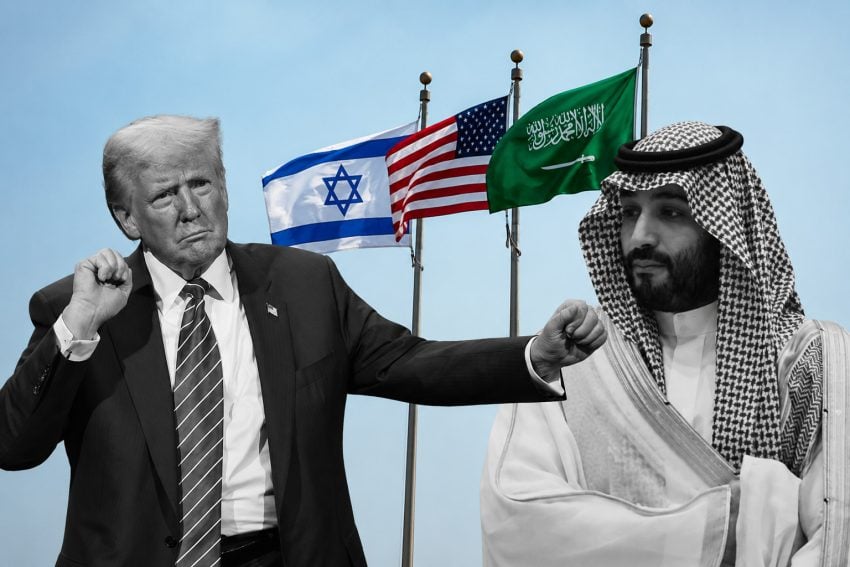
RIYADH – United States raised stakes in Middle East diplomacy after President Donald Trump declared that Saudi Arabia will not receive Washington’s approval for a long-awaited civilian nuclear agreement unless it formally joins the Abraham Accords and normalizes relations with Israel.
POTUS made it clear that the proposed US-Saudi civilian nuclear deal would move forward only if Riyadh becomes part of the Abraham Accords, describing the agreement as strictly for peaceful purposes with no uranium enrichment permitted.
Trump said the agreement between the US Department of Energy and Saudi Arabia would be similar to civilian nuclear arrangements already in place in countries such as Iran, the United Arab Emirates and others, emphasizing that the facilities would be exclusively for non-military use.
The announcement effectively links one of Saudi Arabia’s most important ambitions, a domestic civilian nuclear program, to one of Washington’s biggest diplomatic goals in the Middle East, expanding the Abraham Accords.
KSA long viewed a civilian nuclear program as part of its energy diversification plans under Vision 2030. However, the Kingdom also sees nuclear technology as an important strategic hedge against regional rival Iran. Crown Prince Mohammed bin Salman has repeatedly warned that if Iran acquires a nuclear weapon, Saudi Arabia would seek to match its capabilities, making any nuclear cooperation agreement highly significant for the region’s future security landscape.
Despite growing unofficial cooperation between Saudi Arabia and Israel in recent years, Riyadh consistently maintained that full diplomatic normalization will only happen if there is a clear and irreversible path toward the establishment of an independent Palestinian state based on the two-state solution, with East Jerusalem as its capital.
Riyadh sought additional assurances before any breakthrough with Israel, including meaningful changes to Israeli policies in the occupied West Bank, while some discussions have suggested that progress could depend on political changes within Israel itself.
Trump’s latest statement now places the proposed civilian nuclear agreement directly at the center of one of the Middle East’s most complex diplomatic equations, where nuclear cooperation, regional security, Iran, Israel and the Palestinian issue have become increasingly interconnected.
Trump suggests Pakistan, other Muslim nations could join Expanded Abraham Accords amid Iran Talks