

ISLAMABAD – The Moon will slowly slip into Earth’s shadow on March 3 as its bright silver glow fading into a deep, more commonly known as Blood Moon. For brief moment, it will look as if the heavens themselves are holding their breath, an ancient spectacle that once sparked myths and wonder, but today still leaves us staring upward in silent amazement.
Blood moon 2026 is rare total lunar eclipse that turns the familiar face of the Moon into something mysterious and breathtaking. Whether seen in person or through a screen, it reminds us that the universe is always writing stories. The stunning celestial event is on the horizon as the first total lunar eclipse of 2026 is set to occur on March 3. During this total eclipse, the Moon will pass through Earth’s shadow and take on a deep reddish glow—a sight that has fascinated astronomers and sky enthusiasts for centuries.
This year’s event is particularly significant because it is the only total lunar eclipse of 2026. Those who miss it will have to wait for the next opportunity, which is not expected until the New Year’s Eve eclipse of 2028.
Blood Moon 2026: Timing and Key Details
The eclipse will start at 2:50 PM Pakistan Standard Time (PST) on March 3 Tuesday. The most spectacular phase, the totality, will occur at 4:33 PM PST when the Moon is fully immersed in Earth’s shadow and transforms into its characteristic red hue.
The total phase of the eclipse will last for around an hour, offering mesmerizing display as the lunar surface glows in deep shades of crimson. This time, Skywatchers in Pakistan will unfortunately not be able to witness the event directly, as the eclipse will not be visible from the region.
Where Can It Be Seen?
The best views of the blood moon will be available in parts of:
-
Central and North America
-
Northeast Asia
-
Australia
-
Regions of the Central Pacific
For those in areas where visibility is not possible, astronomy experts recommend following live streams and online broadcasts to experience the event virtually.
Online coverage is expected from major space and scientific organizations, which will provide real-time updates and visual feeds of the eclipse.
What is Blood Moon?
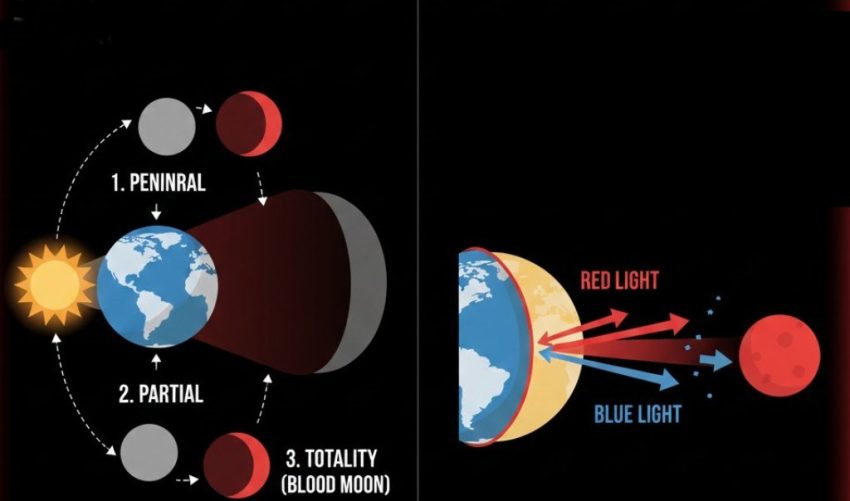
The blood-red coloration of the Moon during a total eclipse is a natural scientific phenomenon rather than a mysterious or supernatural occurrence. It happens due to Rayleigh scattering, the same process that creates red sunsets. Earth’s atmosphere filters out shorter blue and green wavelengths of sunlight and allows only the longer red wavelengths to reach the Moon’s surface, giving it its striking crimson appearance.
While the eclipse will not be visible in Pakistan, astronomy lovers can still engage with the event through digital platforms and online broadcasts. Experts encourage skywatchers to follow reputable space science organizations to witness the spectacle remotely and learn more about this extraordinary cosmic phenomenon.
IN PICS: Blood Moon lights up Pakistani Skies during Lunar Eclipse