
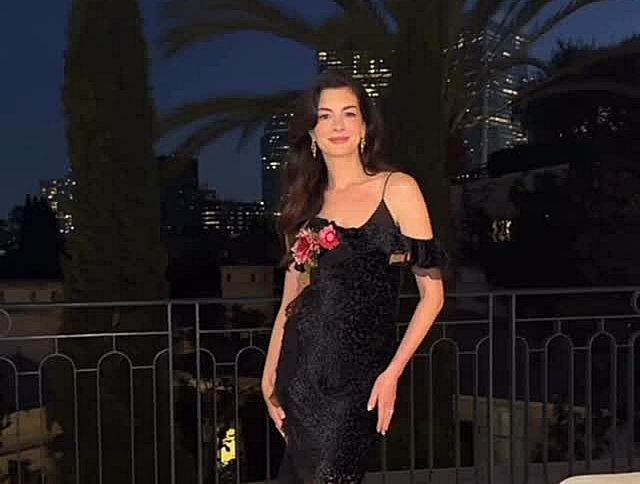
Hollywood star Anne Hathaway sets social media on fire as she dropped phrase “Inshallah” in a recent interview, and fans are guessing whether the Modern Love actoress embraced Islam.
The frenzy started when Anne Hathaway, speaking in an April 2026 People magazine interview said: “I want to have a long, healthy life, Inshallah, I hope so.”
That one phrase, Inshallah, meaning If Allah Wills, was enough to send social media into overdrive. Clips quickly went viral, with users on X (formerly Twitter) reacting in disbelief, excitement, and curiosity. Some praised her with comments like “MashaAllah,” while others began speculating whether the Oscar-winning actress had embraced Islam.
View this post on Instagram
But despite the online buzz, there is no truth to claims of the Hollywood star’s religious conversion.
“Inshallah” is a common expression used by Muslims worldwide, but it’s also widely spoken across Arabic-speaking communities, including by Christians and people of other faiths—as a way to express hope for the future. Hathaway’s usage appeared natural and contextually accurate, which likely fueled both admiration and confusion.
Hathaway’s personal beliefs have long been described as evolving rather than fixed. She was raised Roman Catholic and, at one point in her childhood, even considered becoming a nun. However, during her teenage years, her family distanced themselves from the Catholic Church after her brother came out as gay, due to disagreements with its stance on homosexuality. They later spent time in the Episcopal Church.
Hathaway said her spirituality is still a “work in progress” and not tied to any single organized religion. Through her husband, Adam Shulman, she has also participated in Jewish traditions, including having a Jewish wedding ceremony, though she does not identify as Jewish either.
While she has connections with people from diverse backgrounds and has supported humanitarian causes globally, none of this points to a change in her faith.
This is not the first time a celebrity’s use of culturally significant language has been blown out of proportion. Social media thrives on quick interpretations, and moments like these often get exaggerated into full-blown narratives for engagement.